#![allow(deprecated, unused)]
use crate::util::{COption, CPathBuf, CVec, Pair, Utf8String};
use std::{
path::PathBuf,
sync::{Mutex, Weak},
};
#[derive(Debug)]
#[repr(u16)]
pub enum WindowEvent {
/// The activation token was delivered back and now could be used.
ActivationTokenDone {
serial: AsyncRequestSerial,
token: ActivationToken,
},
/// The size of the window's surface has changed.
///
/// Contains the new dimensions of the surface (can also be retrieved with
/// [`Window::surface_size`]).
///
/// This event will not necessarily be emitted upon window creation, query
/// [`Window::surface_size`] if you need to determine the surface's initial size.
///
/// [`Window::surface_size`]: crate::window::Window::surface_size
SurfaceResized(PhysicalSize<u32>),
/// The position of the window has changed.
///
/// Contains the window's new position in desktop coordinates (can also be retrieved with
/// [`Window::outer_position`]).
///
/// ## Platform-specific
///
/// - **iOS / Android / Web / Wayland:** Unsupported.
Moved(PhysicalPosition<i32>),
/// The window has been requested to close.
CloseRequested,
/// The window has been destroyed.
Destroyed,
/// A file drag operation has entered the window.
DragEntered {
/// List of paths that are being dragged onto the window.
paths: CVec<CPathBuf>,
/// (x,y) coordinates in pixels relative to the top-left corner of the window. May be
/// negative on some platforms if something is dragged over a window's decorations (title
/// bar, frame, etc).
position: PhysicalPosition<f64>,
},
/// A file drag operation has moved over the window.
DragMoved {
/// (x,y) coordinates in pixels relative to the top-left corner of the window. May be
/// negative on some platforms if something is dragged over a window's decorations (title
/// bar, frame, etc).
position: PhysicalPosition<f64>,
},
/// The file drag operation has dropped file(s) on the window.
DragDropped {
/// List of paths that are being dragged onto the window.
paths: CVec<CPathBuf>,
/// (x,y) coordinates in pixels relative to the top-left corner of the window. May be
/// negative on some platforms if something is dragged over a window's decorations (title
/// bar, frame, etc).
position: PhysicalPosition<f64>,
},
/// The file drag operation has been cancelled or left the window.
DragLeft {
/// (x,y) coordinates in pixels relative to the top-left corner of the window. May be
/// negative on some platforms if something is dragged over a window's decorations (title
/// bar, frame, etc).
///
/// ## Platform-specific
///
/// - **Windows:** Always emits [`None`].
position: COption<PhysicalPosition<f64>>,
},
/// The window gained or lost focus.
///
/// The parameter is true if the window has gained focus, and false if it has lost focus.
///
/// Windows are unfocused upon creation, but will usually be focused by the system soon
/// afterwards.
Focused(bool),
/// An event from the keyboard has been received.
///
/// ## Platform-specific
/// - **Windows:** The shift key overrides NumLock. In other words, while shift is held down,
/// numpad keys act as if NumLock wasn't active. When this is used, the OS sends fake key
/// events which are not marked as `is_synthetic`.
/// - **iOS:** Unsupported.
KeyboardInput {
device_id: COption<DeviceId>,
event: KeyEvent,
/// If `true`, the event was generated synthetically by winit
/// in one of the following circumstances:
///
/// * Synthetic key press events are generated for all keys pressed when a window gains
/// focus. Likewise, synthetic key release events are generated for all keys pressed when
/// a window goes out of focus. ***Currently, this is only functional on X11 and
/// Windows***
///
/// Otherwise, this value is always `false`.
is_synthetic: bool,
},
/// The keyboard modifiers have changed.
ModifiersChanged(Modifiers),
/// An event from an input method.
///
/// **Note:** You have to explicitly enable this event using [`Window::set_ime_allowed`].
///
/// ## Platform-specific
///
/// - **iOS / Android / Web / Orbital:** Unsupported.
Ime(Ime),
/// The pointer has moved on the window.
PointerMoved {
device_id: COption<DeviceId>,
/// (x,y) coordinates in pixels relative to the top-left corner of the window. Because the
/// range of this data is limited by the display area and it may have been
/// transformed by the OS to implement effects such as pointer acceleration, it
/// should not be used to implement non-pointer-like interactions such as 3D camera
/// control. For that, consider [`DeviceEvent::PointerMotion`].
///
/// ## Platform-specific
///
/// **Web:** Doesn't take into account CSS [`border`], [`padding`], or [`transform`].
///
/// [`border`]: https://developer.mozilla.org/en-US/docs/Web/CSS/border
/// [`padding`]: https://developer.mozilla.org/en-US/docs/Web/CSS/padding
/// [`transform`]: https://developer.mozilla.org/en-US/docs/Web/CSS/transform
position: PhysicalPosition<f64>,
/// Indicates whether the event is created by a primary pointer.
///
/// A pointer is considered primary when it's a mouse, the first finger in a multi-touch
/// interaction, or an unknown pointer source.
primary: bool,
source: PointerSource,
},
/// The pointer has entered the window.
PointerEntered {
device_id: COption<DeviceId>,
/// The position of the pointer when it entered the window.
///
/// ## Platform-specific
///
/// - **Orbital: Always emits `(0., 0.)`.
/// - **Web:** Doesn't take into account CSS [`border`], [`padding`], or [`transform`].
///
/// [`border`]: https://developer.mozilla.org/en-US/docs/Web/CSS/border
/// [`padding`]: https://developer.mozilla.org/en-US/docs/Web/CSS/padding
/// [`transform`]: https://developer.mozilla.org/en-US/docs/Web/CSS/transform
position: PhysicalPosition<f64>,
/// Indicates whether the event is created by a primary pointer.
///
/// A pointer is considered primary when it's a mouse, the first finger in a multi-touch
/// interaction, or an unknown pointer source.
primary: bool,
kind: PointerKind,
},
/// The pointer has left the window.
PointerLeft {
device_id: COption<DeviceId>,
/// The position of the pointer when it left the window. The position reported can be
/// outside the bounds of the window.
///
/// ## Platform-specific
///
/// - **Orbital/Windows:** Always emits [`None`].
/// - **Web:** Doesn't take into account CSS [`border`], [`padding`], or [`transform`].
///
/// [`border`]: https://developer.mozilla.org/en-US/docs/Web/CSS/border
/// [`padding`]: https://developer.mozilla.org/en-US/docs/Web/CSS/padding
/// [`transform`]: https://developer.mozilla.org/en-US/docs/Web/CSS/transform
position: COption<PhysicalPosition<f64>>,
/// Indicates whether the event is created by a primary pointer.
///
/// A pointer is considered primary when it's a mouse, the first finger in a multi-touch
/// interaction, or an unknown pointer source.
primary: bool,
kind: PointerKind,
},
/// A mouse wheel movement or touchpad scroll occurred.
MouseWheel {
device_id: COption<DeviceId>,
delta: MouseScrollDelta,
phase: TouchPhase,
},
/// An mouse button press has been received.
PointerButton {
device_id: COption<DeviceId>,
state: ElementState,
/// The position of the pointer when the button was pressed.
///
/// ## Platform-specific
///
/// - **Orbital: Always emits `(0., 0.)`.
/// - **Web:** Doesn't take into account CSS [`border`], [`padding`], or [`transform`].
///
/// [`border`]: https://developer.mozilla.org/en-US/docs/Web/CSS/border
/// [`padding`]: https://developer.mozilla.org/en-US/docs/Web/CSS/padding
/// [`transform`]: https://developer.mozilla.org/en-US/docs/Web/CSS/transform
position: PhysicalPosition<f64>,
/// Indicates whether the event is created by a primary pointer.
///
/// A pointer is considered primary when it's a mouse, the first finger in a multi-touch
/// interaction, or an unknown pointer source.
primary: bool,
button: ButtonSource,
},
/// Two-finger pinch gesture, often used for magnification.
///
/// ## Platform-specific
///
/// - Only available on **macOS**, **iOS**, and **Wayland**.
/// - On iOS, not recognized by default. It must be enabled when needed.
PinchGesture {
device_id: COption<DeviceId>,
/// Positive values indicate magnification (zooming in) and negative
/// values indicate shrinking (zooming out).
///
/// This value may be NaN.
delta: f64,
phase: TouchPhase,
},
/// N-finger pan gesture
///
/// ## Platform-specific
///
/// - Only available on **iOS** and **Wayland**.
/// - On iOS, not recognized by default. It must be enabled when needed.
PanGesture {
device_id: COption<DeviceId>,
/// Change in pixels of pan gesture from last update.
delta: PhysicalPosition<f32>,
phase: TouchPhase,
},
/// Double tap gesture.
///
/// On a Mac, smart magnification is triggered by a double tap with two fingers
/// on the trackpad and is commonly used to zoom on a certain object
/// (e.g. a paragraph of a PDF) or (sort of like a toggle) to reset any zoom.
/// The gesture is also supported in Safari, Pages, etc.
///
/// The event is general enough that its generating gesture is allowed to vary
/// across platforms. It could also be generated by another device.
///
/// Unfortunately, neither [Windows](https://support.microsoft.com/en-us/windows/touch-gestures-for-windows-a9d28305-4818-a5df-4e2b-e5590f850741)
/// nor [Wayland](https://wayland.freedesktop.org/libinput/doc/latest/gestures.html)
/// support this gesture or any other gesture with the same effect.
///
/// ## Platform-specific
///
/// - Only available on **macOS 10.8** and later, and **iOS**.
/// - On iOS, not recognized by default. It must be enabled when needed.
DoubleTapGesture { device_id: COption<DeviceId> },
/// Two-finger rotation gesture.
///
/// Positive delta values indicate rotation counterclockwise and
/// negative delta values indicate rotation clockwise.
///
/// ## Platform-specific
///
/// - Only available on **macOS**, **iOS**, and **Wayland**.
/// - On iOS, not recognized by default. It must be enabled when needed.
RotationGesture {
device_id: COption<DeviceId>,
/// change in rotation in degrees
delta: f32,
phase: TouchPhase,
},
/// Touchpad pressure event.
///
/// ## Platform-specific
///
/// - **macOS**: Only supported on Apple forcetouch-capable macbooks.
/// - **Android / iOS / Wayland / X11 / Windows / Orbital / Web:** Unsupported.
TouchpadPressure {
device_id: COption<DeviceId>,
/// Value between 0 and 1 representing how hard the touchpad is being
/// pressed.
pressure: f32,
/// Represents the click level.
stage: i64,
},
/// The window's scale factor has changed.
///
/// The following user actions can cause DPI changes:
///
/// * Changing the display's resolution.
/// * Changing the display's scale factor (e.g. in Control Panel on Windows).
/// * Moving the window to a display with a different scale factor.
///
/// To update the window size, use the provided [`SurfaceSizeWriter`] handle. By default, the
/// window is resized to the value suggested by the OS, but it can be changed to any value.
///
/// This event will not necessarily be emitted upon window creation, query
/// [`Window::scale_factor`] if you need to determine the window's initial scale factor.
///
/// For more information about DPI in general, see the [`dpi`] crate.
///
/// [`Window::scale_factor`]: crate::window::Window::scale_factor
ScaleFactorChanged {
scale_factor: f64,
/// Handle to update surface size during scale changes.
///
/// See [`SurfaceSizeWriter`] docs for more details.
surface_size_writer: SurfaceSizeWriter,
},
/// The system window theme has changed.
///
/// Applications might wish to react to this to change the theme of the content of the window
/// when the system changes the window theme.
///
/// This only reports a change if the window theme was not overridden by [`Window::set_theme`].
///
/// ## Platform-specific
///
/// - **iOS / Android / X11 / Wayland / Orbital:** Unsupported.
ThemeChanged(Theme),
/// The window has been occluded (completely hidden from view).
///
/// This is different to window visibility as it depends on whether the window is closed,
/// minimised, set invisible, or fully occluded by another window.
///
/// ## Platform-specific
///
/// ### iOS
///
/// On iOS, the `Occluded(false)` event is emitted in response to an
/// [`applicationWillEnterForeground`] callback which means the application should start
/// preparing its data. The `Occluded(true)` event is emitted in response to an
/// [`applicationDidEnterBackground`] callback which means the application should free
/// resources (according to the [iOS application lifecycle]).
///
/// [`applicationWillEnterForeground`]: https://developer.apple.com/documentation/uikit/uiapplicationdelegate/1623076-applicationwillenterforeground
/// [`applicationDidEnterBackground`]: https://developer.apple.com/documentation/uikit/uiapplicationdelegate/1622997-applicationdidenterbackground
/// [iOS application lifecycle]: https://developer.apple.com/documentation/uikit/app_and_environment/managing_your_app_s_life_cycle
///
/// ### Others
///
/// - **Web:** Doesn't take into account CSS [`border`], [`padding`], or [`transform`].
/// - **Android / Wayland / Windows / Orbital:** Unsupported.
///
/// [`border`]: https://developer.mozilla.org/en-US/docs/Web/CSS/border
/// [`padding`]: https://developer.mozilla.org/en-US/docs/Web/CSS/padding
/// [`transform`]: https://developer.mozilla.org/en-US/docs/Web/CSS/transform
Occluded(bool),
/// Emitted when a window should be redrawn.
///
/// This gets triggered in a few scenarios:
/// - The OS has performed an operation that's invalidated the window's contents (such as
/// resizing the window, or changing [the safe area]).
/// - The application has explicitly requested a redraw via [`Window::request_redraw`].
///
/// Winit will aggregate duplicate redraw requests into a single event, to
/// help avoid duplicating rendering work.
///
/// [the safe area]: crate::window::Window::safe_area
RedrawRequested,
}
/// Represents the kind type of a pointer event.
///
/// ## Platform-specific
///
/// **Wayland/X11:** [`Unknown`](Self::Unknown) device types are converted to known variants by the
/// system.
#[derive(Debug)]
#[repr(u8)]
pub enum PointerKind {
Mouse,
/// See [`PointerSource::Touch`] for more details.
///
/// ## Platform-specific
///
/// **macOS:** Unsupported.
Touch(FingerId),
TabletTool(TabletToolKind),
Unknown,
}
/// Represents the pointer type and its data for a pointer event.
///
/// **Wayland/X11:** [`Unknown`](Self::Unknown) device types are converted to known variants by the
/// system.
#[derive(Debug)]
#[repr(u8)]
pub enum PointerSource {
Mouse,
/// Represents a touch event.
///
/// Every time the user touches the screen, a [`WindowEvent::PointerEntered`] and a
/// [`WindowEvent::PointerButton`] with [`ElementState::Pressed`] event with an unique
/// identifier for the finger is emitted. When a finger is lifted, a
/// [`WindowEvent::PointerButton`] with [`ElementState::Released`] and a
/// [`WindowEvent::PointerLeft`] event is generated with the same [`FingerId`].
///
/// After a [`WindowEvent::PointerEntered`] event has been emitted, there may be zero or more
/// [`WindowEvent::PointerMoved`] events when the finger is moved or the touch pressure
/// changes.
///
/// A [`WindowEvent::PointerLeft`] without a [`WindowEvent::PointerButton`] with
/// [`ElementState::Released`] event is emitted when the system has canceled tracking this
/// touch, such as when the window loses focus, or on mobile devices if the user moves the
/// device against their face.
///
/// The [`FingerId`] may be reused by the system after a [`WindowEvent::PointerLeft`] event.
/// The user should assume that a new [`WindowEvent::PointerEntered`] event received with the
/// same ID has nothing to do with the old finger and is a new finger.
///
/// ## Platform-specific
///
/// **macOS:** Unsupported.
Touch {
finger_id: FingerId,
/// Describes how hard the screen was pressed. May be [`None`] if the hardware does not
/// support pressure sensitivity.
///
/// ## Platform-specific
///
/// - **MacOS / Orbital / Wayland / X11:** Always emits [`None`].
/// - **Android:** Will never be [`None`]. If the device doesn't support pressure
/// sensitivity, force will either be 0.0 or 1.0. Also see the
/// [android documentation](https://developer.android.com/reference/android/view/MotionEvent#AXIS_PRESSURE).
/// - **Web:** Will never be [`None`]. If the device doesn't support pressure sensitivity,
/// force will be 0.5 when a button is pressed or 0.0 otherwise.
force: COption<Force>,
},
TabletTool {
/// Describes as which tool kind the interaction happened.
kind: TabletToolKind,
/// Describes how the tool was held and used.
data: TabletToolData,
},
Unknown,
}
/// Represents the pointer type of a [`WindowEvent::PointerButton`].
///
/// **Wayland/X11:** [`Unknown`](Self::Unknown) device types are converted to known variants by the
/// system.
#[derive(Debug)]
#[repr(u8)]
pub enum ButtonSource {
Mouse(MouseButton),
/// See [`PointerSource::Touch`] for more details.
///
/// ## Platform-specific
///
/// **macOS:** Unsupported.
Touch {
finger_id: FingerId,
force: COption<Force>,
},
TabletTool {
kind: TabletToolKind,
button: TabletToolButton,
data: TabletToolData,
},
/// A pointer button of unknown source.
///
/// Codes are undefined and may not be reproducible across platforms or winit versions.
Unknown(u16),
}
/// Identifier of an input device.
///
/// Whenever you receive an event arising from a particular input device, this event contains a
/// `DeviceId` which identifies its origin. Note that devices may be virtual (representing an
/// on-screen cursor and keyboard focus) or physical. Virtual devices typically aggregate inputs
/// from multiple physical devices.
#[derive(Debug)]
#[repr(transparent)]
pub struct DeviceId(i64);
/// Identifier of a finger in a touch event.
///
/// Whenever a touch event is received it contains a `FingerId` which uniquely identifies the finger
/// used for the current interaction.
#[derive(Debug)]
#[repr(transparent)]
pub struct FingerId(pub usize);
/// Represents raw hardware events that are not associated with any particular window.
///
/// Useful for interactions that diverge significantly from a conventional 2D GUI, such as 3D camera
/// or first-person game controls. Many physical actions, such as mouse movement, can produce both
/// device and [window events]. Because window events typically arise from virtual devices
/// (corresponding to GUI pointers and keyboard focus) the device IDs may not match.
///
/// Note that these events are delivered regardless of input focus.
///
/// [window events]: WindowEvent
#[derive(Debug)]
#[repr(u8)]
pub enum DeviceEvent {
/// Change in physical position of a pointing device.
///
/// This represents raw, unfiltered physical motion. Not to be confused with
/// [`WindowEvent::PointerMoved`].
///
/// ## Platform-specific
///
/// **Web:** Only returns raw data, not OS accelerated, if [`CursorGrabMode::Locked`] is used
/// and browser support is available.
///
/// [`CursorGrabMode::Locked`]: crate::window::CursorGrabMode::Locked
PointerMotion {
/// (x, y) change in position in unspecified units.
///
/// Different devices may use different units.
delta: (f64, f64),
},
/// Physical scroll event
//
// NOTE: Flattened-in `MouseScrollDelta` for compact C repr matching Rust size from:
//
// MouseWheel {
// delta: MouseScrollDelta,
// },
//
// to:
MouseWheelLineDelta(f32, f32),
MouseWheelPixelDelta(PhysicalPosition<f64>),
Button {
button: ButtonId,
state: ElementState,
},
Key(RawKeyEvent),
}
/// Describes a keyboard input as a raw device event.
///
/// Note that holding down a key may produce repeated `RawKeyEvent`s. The
/// operating system doesn't provide information whether such an event is a
/// repeat or the initial keypress. An application may emulate this by, for
/// example keeping a Map/Set of pressed keys and determining whether a keypress
/// corresponds to an already pressed key.
#[derive(Debug)]
#[repr(C)]
pub struct RawKeyEvent {
pub physical_key: PhysicalKey,
pub state: ElementState,
}
/// Describes a keyboard input targeting a window.
#[derive(Debug)]
#[repr(C)]
pub struct KeyEvent {
/// Represents the position of a key independent of the currently active layout.
///
/// It also uniquely identifies the physical key (i.e. it's mostly synonymous with a scancode).
/// The most prevalent use case for this is games. For example the default keys for the player
/// to move around might be the W, A, S, and D keys on a US layout. The position of these keys
/// is more important than their label, so they should map to Z, Q, S, and D on an "AZERTY"
/// layout. (This value is `KeyCode::KeyW` for the Z key on an AZERTY layout.)
///
/// ## Caveats
///
/// - Certain niche hardware will shuffle around physical key positions, e.g. a keyboard that
/// implements DVORAK in hardware (or firmware)
/// - Your application will likely have to handle keyboards which are missing keys that your
/// own keyboard has.
/// - Certain `KeyCode`s will move between a couple of different positions depending on what
/// layout the keyboard was manufactured to support.
///
/// **Because of these caveats, it is important that you provide users with a way to configure
/// most (if not all) keybinds in your application.**
///
/// ## `Fn` and `FnLock`
///
/// `Fn` and `FnLock` key events are *exceedingly unlikely* to be emitted by Winit. These keys
/// are usually handled at the hardware or OS level, and aren't surfaced to applications. If
/// you somehow see this in the wild, we'd like to know :)
pub physical_key: PhysicalKey,
/// This value is affected by all modifiers except <kbd>Ctrl</kbd>.
///
/// This has two use cases:
/// - Allows querying whether the current input is a Dead key.
/// - Allows handling key-bindings on platforms which don't support [`key_without_modifiers`].
///
/// If you use this field (or [`key_without_modifiers`] for that matter) for keyboard
/// shortcuts, **it is important that you provide users with a way to configure your
/// application's shortcuts so you don't render your application unusable for users with an
/// incompatible keyboard layout.**
///
/// ## Platform-specific
/// - **Web:** Dead keys might be reported as the real key instead of `Dead` depending on the
/// browser/OS.
///
/// [`key_without_modifiers`]: Self::key_without_modifiers
pub logical_key: Key,
/// Contains the text produced by this keypress.
///
/// In most cases this is identical to the content
/// of the `Character` variant of `logical_key`.
/// However, on Windows when a dead key was pressed earlier
/// but cannot be combined with the character from this
/// keypress, the produced text will consist of two characters:
/// the dead-key-character followed by the character resulting
/// from this keypress.
///
/// An additional difference from `logical_key` is that
/// this field stores the text representation of any key
/// that has such a representation. For example when
/// `logical_key` is `Key::Named(NamedKey::Enter)`, this field is `Some("\r")`.
///
/// This is `None` if the current keypress cannot
/// be interpreted as text.
///
/// See also [`text_with_all_modifiers`][Self::text_with_all_modifiers].
pub text: COption<Utf8String>,
/// Contains the location of this key on the keyboard.
///
/// Certain keys on the keyboard may appear in more than once place. For example, the "Shift"
/// key appears on the left side of the QWERTY keyboard as well as the right side. However,
/// both keys have the same symbolic value. Another example of this phenomenon is the "1"
/// key, which appears both above the "Q" key and as the "Keypad 1" key.
///
/// This field allows the user to differentiate between keys like this that have the same
/// symbolic value but different locations on the keyboard.
///
/// See the [`KeyLocation`] type for more details.
///
/// [`KeyLocation`]: crate::keyboard::KeyLocation
pub location: KeyLocation,
/// Whether the key is being pressed or released.
///
/// See the [`ElementState`] type for more details.
pub state: ElementState,
/// Whether or not this key is a key repeat event.
///
/// On some systems, holding down a key for some period of time causes that key to be repeated
/// as though it were being pressed and released repeatedly. This field is `true` if and only
/// if this event is the result of one of those repeats.
///
/// # Example
///
/// In games, you often want to ignore repeated key events - this can be
/// done by ignoring events where this property is set.
///
/// ```no_run
/// use winit_core::event::{ElementState, KeyEvent, WindowEvent};
/// use winit_core::keyboard::{KeyCode, PhysicalKey};
/// # let window_event = WindowEvent::RedrawRequested; // To make the example compile
/// match window_event {
/// WindowEvent::KeyboardInput {
/// event:
/// KeyEvent {
/// physical_key: PhysicalKey::Code(KeyCode::KeyW),
/// state: ElementState::Pressed,
/// repeat: false,
/// ..
/// },
/// ..
/// } => {
/// // The physical key `W` was pressed, and it was not a repeat
/// },
/// _ => {}, // Handle other events
/// }
/// ```
pub repeat: bool,
/// Similar to [`text`][Self::text], except that this is affected by <kbd>Ctrl</kbd> and may
/// produce ASCII control characters.
///
/// For example, pressing <kbd>Ctrl</kbd>+<kbd>space</kbd> produces `Some("\x00")`.
///
/// ## Platform-specific
///
/// - **Android:** Unimplemented, this field is always the same value as `text`.
/// - **iOS:** Unimplemented, this field is always the same value as `text`.
/// - **Web:** Unsupported, this field is always the same value as `text`.
pub text_with_all_modifiers: COption<Utf8String>,
/// This value ignores all modifiers including, but not limited to <kbd>Shift</kbd>,
/// <kbd>Caps Lock</kbd>, and <kbd>Ctrl</kbd>. In most cases this means that the
/// unicode character in the resulting string is lowercase.
///
/// This is useful for key-bindings / shortcut key combinations.
///
/// In case [`logical_key`][Self::logical_key] reports [`Dead`][keyboard::Key::Dead],
/// this will still report the key as `Character` according to the current keyboard
/// layout. This value cannot be `Dead`.
///
/// ## Platform-specific
///
/// - **Android:** Unimplemented, this field is always the same value as `logical_key`.
/// - **iOS:** Unimplemented, this field is always the same value as `logical_key`.
/// - **Web:** Unsupported, this field is always the same value as `logical_key`.
pub key_without_modifiers: Key,
}
/// Describes keyboard modifiers event.
#[derive(Debug)]
#[repr(C)]
pub struct Modifiers {
pub(crate) state: ModifiersState,
// NOTE: Currently active modifiers keys (logically, but not necessarily physically, pressed).
//
// The field providing a metadata, it shouldn't be used as a source of truth.
pub(crate) pressed_mods: ModifiersKeys,
}
/// Describes [input method](https://en.wikipedia.org/wiki/Input_method) events.
///
/// The `Ime` events must be applied in the order they arrive.
///
/// This is also called a "composition event".
///
/// Most keypresses using a latin-like keyboard layout simply generate a
/// [`WindowEvent::KeyboardInput`]. However, one couldn't possibly have a key for every single
/// unicode character that the user might want to type
/// - so the solution operating systems employ is to allow the user to type these using _a sequence
/// of keypresses_ instead.
///
/// A prominent example of this is accents - many keyboard layouts allow you to first click the
/// "accent key", and then the character you want to apply the accent to. In this case, some
/// platforms will generate the following event sequence:
///
/// ```ignore
/// // Press "`" key
/// Ime::Preedit("`", Some((0, 0)))
/// // Press "E" key
/// Ime::Preedit("", None) // Synthetic event generated by winit to clear preedit.
/// Ime::Commit("é")
/// ```
///
/// Additionally, certain input devices are configured to display a candidate box that allow the
/// user to select the desired character interactively. (To properly position this box, you must use
/// [`Window::set_ime_cursor_area`].)
///
/// An example of a keyboard layout which uses candidate boxes is pinyin. On a latin keyboard the
/// following event sequence could be obtained:
///
/// ```ignore
/// // Press "A" key
/// Ime::Preedit("a", Some((1, 1)))
/// // Press "B" key
/// Ime::Preedit("a b", Some((3, 3)))
/// // Press left arrow key
/// Ime::Preedit("a b", Some((1, 1)))
/// // Press space key
/// Ime::Preedit("啊b", Some((3, 3)))
/// // Press space key
/// Ime::Preedit("", None) // Synthetic event generated by winit to clear preedit.
/// Ime::Commit("啊不")
/// ```
#[derive(Debug)]
#[repr(u8)]
pub enum Ime {
/// Notifies when the IME was enabled.
///
/// After getting this event you could receive [`Preedit`][Self::Preedit] and
/// [`Commit`][Self::Commit] events. You should also start performing IME related requests
/// like [`Window::set_ime_cursor_area`].
Enabled,
/// Notifies when a new composing text should be set at the cursor position.
///
/// The value represents a pair of the preedit string and the cursor begin position and end
/// position. When it's `None`, the cursor should be hidden. When `String` is an empty string
/// this indicates that preedit was cleared.
///
/// The cursor position is byte-wise indexed, assuming UTF-8.
Preedit(Utf8String, COption<Pair<usize, usize>>),
/// Notifies when text should be inserted into the editor widget.
///
/// Right before this event winit will send empty [`Self::Preedit`] event.
Commit(Utf8String),
/// Delete text surrounding the cursor or selection.
///
/// This event does not affect either the pre-edit string.
/// This means that the application must first remove the pre-edit,
/// then execute the deletion, then insert the removed text back.
///
/// This event assumes text is stored in UTF-8.
DeleteSurrounding {
/// Bytes to remove before the selection
before_bytes: usize,
/// Bytes to remove after the selection
after_bytes: usize,
},
/// Notifies when the IME was disabled.
///
/// After receiving this event you won't get any more [`Preedit`][Self::Preedit] or
/// [`Commit`][Self::Commit] events until the next [`Enabled`][Self::Enabled] event. You should
/// also stop issuing IME related requests like [`Window::set_ime_cursor_area`] and clear
/// pending preedit text.
Disabled,
}
/// Describes touch-screen input state.
#[derive(Debug)]
#[repr(u8)]
pub enum TouchPhase {
Started,
Moved,
Ended,
Cancelled,
}
/// Describes the force of a touch event
#[derive(Debug)]
#[repr(u8)]
pub enum Force {
/// On iOS, the force is calibrated so that the same number corresponds to
/// roughly the same amount of pressure on the screen regardless of the
/// device.
Calibrated {
/// The force of the touch, where a value of 1.0 represents the force of
/// an average touch (predetermined by the system, not user-specific).
///
/// The force reported by Apple Pencil is measured along the axis of the
/// pencil. If you want a force perpendicular to the device, you need to
/// calculate this value using the [`TabletToolAngle::altitude`] value.
force: f64,
/// The maximum possible force for a touch.
///
/// The value of this field is sufficiently high to provide a wide
/// dynamic range for values of the `force` field.
max_possible_force: f64,
},
/// If the platform reports the force as normalized, we have no way of
/// knowing how much pressure 1.0 corresponds to – we know it's the maximum
/// amount of force, but as to how much force, you might either have to
/// press really really hard, or not hard at all, depending on the device.
Normalized(f64),
}
/// Identifier for a specific button on some device.
pub type ButtonId = u32;
/// Tablet of the tablet tool.
#[derive(Debug)]
#[repr(u8)]
pub enum TabletToolKind {
Pen,
Eraser,
Brush,
Pencil,
Airbrush,
Finger,
Mouse,
Lens,
}
#[derive(Debug)]
#[repr(C)]
pub struct TabletToolData {
/// The force applied to the tool against the surface.
///
/// When the force information is not available, [`None`] is returned.
///
/// ## Platform-specific
///
/// **Web:** Has no mechanism to detect support, so this will always be [`Some`].
pub force: COption<Force>,
/// Represents normalized tangential pressure, also known as barrel pressure. In the range of
/// -1 to 1. 0 means no tangential pressure is applied. [`None`] means backend or device has no
/// support.
///
/// ## Platform-specific
///
/// **Web:** Has no mechanism to detect support, so this will always be [`Some`] with a value
/// of 0.
pub tangential_force: COption<f32>,
/// The clockwise rotation in degrees of a tool around its own major axis. E.g. twisting a pen
/// around its length. In the range of 0 to 359. [`None`] means backend or device has no
/// support.
///
/// ## Platform-specific
///
/// **Web:** Has no mechanism to detect support, so this will always be [`Some`] with a value
/// of 0.
pub twist: COption<u16>,
/// The plane angle in degrees. [`None`] means backend or device has no support.
///
/// ## Platform-specific
///
/// **Web:** Has no mechanism to detect support, so this will always be [`Some`] with default
/// values.
pub tilt: COption<TabletToolTilt>,
/// The angular position in radians. [`None`] means backend or device has no support.
///
/// ## Platform-specific
///
/// **Web:** Has no mechanism to detect device support, so this will always be [`Some`] with
/// default values unless browser support is lacking.
pub angle: COption<TabletToolAngle>,
}
/// The plane angle in degrees of a tool.
#[derive(Debug)]
#[repr(C)]
pub struct TabletToolTilt {
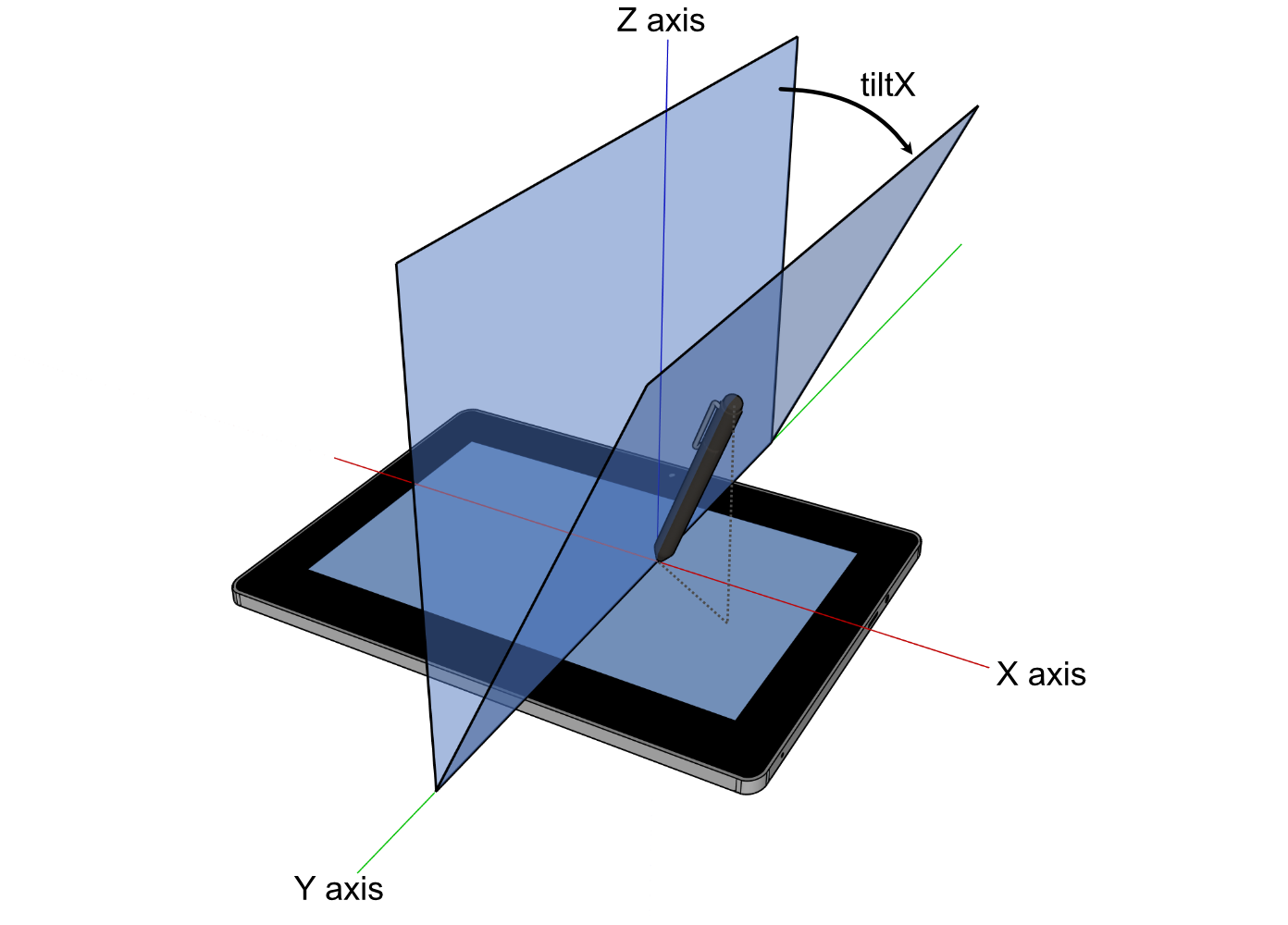
/// The plane angle in degrees between the surface Y-Z plane and the plane containing the tool
/// and the surface Y axis. Positive values are to the right. In the range of -90 to 90. 0
/// means the tool is perpendicular to the surface and is the default.
///
/// 
///
/// <sub>
/// For image attribution, see the
/// <a href="https://github.com/rust-windowing/winit/blob/master/winit/docs/ATTRIBUTION.md">
/// ATTRIBUTION.md
/// </a>
/// file.
/// </sub>
pub x: i8,
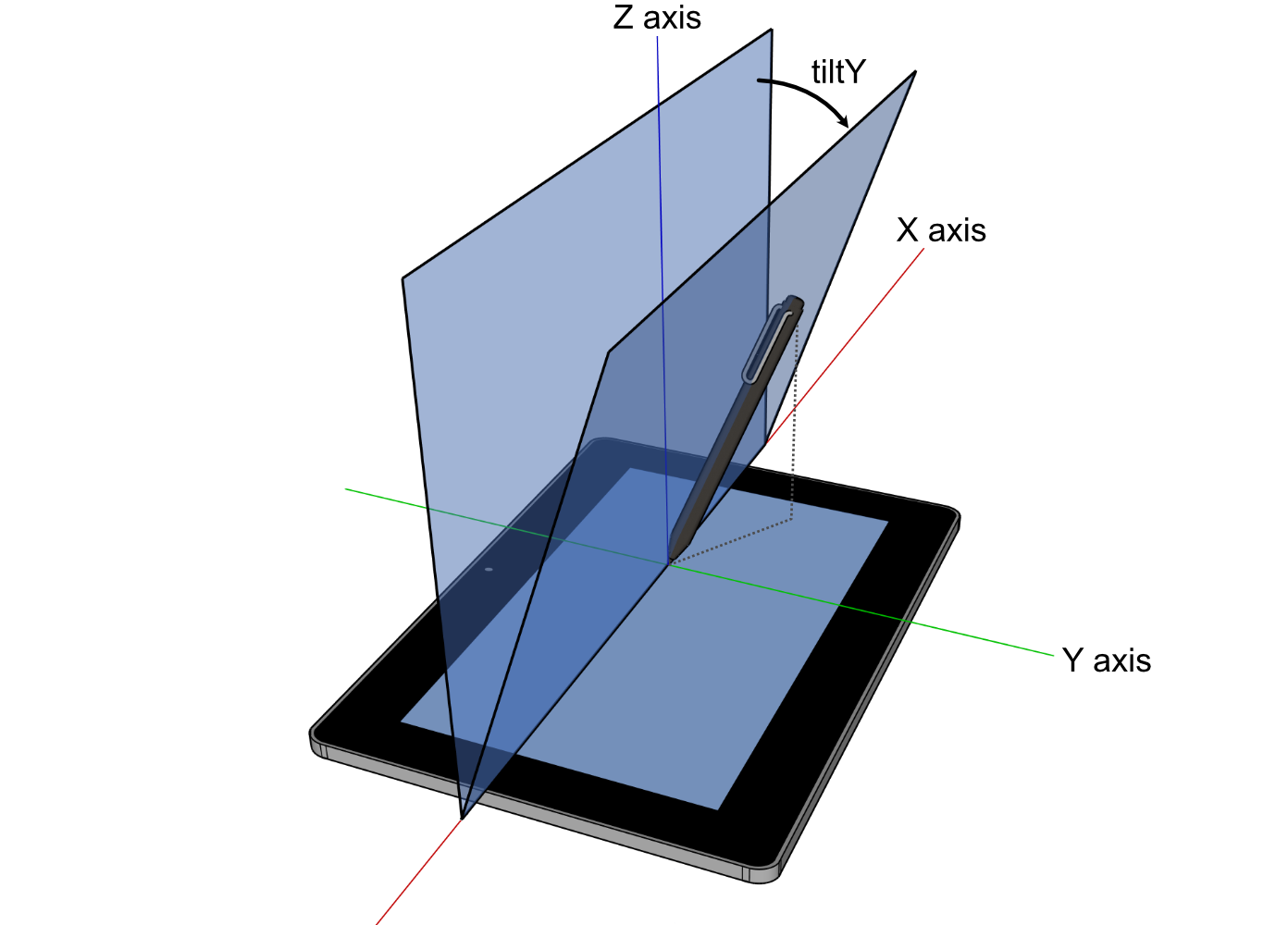
/// The plane angle in degrees between the surface X-Z plane and the plane containing the tool
/// and the surface X axis. Positive values are towards the user. In the range of -90 to
/// 90. 0 means the tool is perpendicular to the surface and is the default.
///
/// 
///
/// <sub>
/// For image attribution, see the
/// <a href="https://github.com/rust-windowing/winit/blob/master/winit/docs/ATTRIBUTION.md">
/// ATTRIBUTION.md
/// </a>
/// file.
/// </sub>
pub y: i8,
}
/// The angular position in radians of a tool.
#[derive(Debug)]
#[repr(C)]
pub struct TabletToolAngle {
/// The altitude angle in radians between the tools perpendicular position to the surface and
/// the surface X-Y plane. In the range of 0, parallel to the surface, to π/2, perpendicular to
/// the surface. π/2 means the tool is perpendicular to the surface and is the default.
///
/// 
///
/// <sub>
/// For image attribution, see the
/// <a href="https://github.com/rust-windowing/winit/blob/master/docs/res/ATTRIBUTION.md">
/// ATTRIBUTION.md
/// </a>
/// file.
/// </sub>
pub altitude: f64,
/// The azimuth angle in radiants representing the rotation between the major axis of the tool
/// and the surface X-Y plane. In the range of 0, 3 o'clock, progressively increasing clockwise
/// to 2π. 0 means the tool is at 3 o'clock or is perpendicular to the surface (`altitude` of
/// π/2) and is the default.
///
/// 
///
/// <sub>
/// For image attribution, see the
/// <a href="https://github.com/rust-windowing/winit/blob/master/docs/res/ATTRIBUTION.md">
/// ATTRIBUTION.md
/// </a>
/// file.
/// </sub>
pub azimuth: f64,
}
/// Describes the input state of a key.
#[derive(Debug)]
#[repr(u8)]
pub enum ElementState {
Pressed,
Released,
}
/// Identifies a button of a mouse controller.
///
/// ## Platform-specific
///
/// The first three buttons should be supported on all platforms.
/// [`Self::Back`] and [`Self::Forward`] are supported on most platforms
/// (when using a compatible mouse).
///
/// - **Android, iOS:** Currently not supported.
/// - **Orbital:** Only left/right/middle buttons are supported at this time.
/// - **Web, Windows:** Supports left/right/middle/back/forward buttons.
/// - **Wayland:** Supports buttons 0..=15.
/// - **macOS:** Supports all button variants.
/// - **X11:** Technically supports further buttons than this (0..=250), these are emitted in
/// `ButtonSource::Unknown`.
#[derive(Debug, Hash, PartialEq, Eq, PartialOrd, Ord, Clone, Copy)]
#[repr(u8)]
pub enum MouseButton {
/// The primary (usually left) button
Left = 0,
/// The secondary (usually right) button
Right = 1,
/// The tertiary (usually middle) button
Middle = 2,
/// The first side button, frequently assigned a back function
Back = 3,
/// The second side button, frequently assigned a forward function
Forward = 4,
/// The sixth button
Button6 = 5,
/// The seventh button
Button7 = 6,
/// The eighth button
Button8 = 7,
/// The ninth button
Button9 = 8,
/// The tenth button
Button10 = 9,
/// The eleventh button
Button11 = 10,
/// The twelfth button
Button12 = 11,
/// The thirteenth button
Button13 = 12,
/// The fourteenth button
Button14 = 13,
/// The fifteenth button
Button15 = 14,
/// The sixteenth button
Button16 = 15,
Button17 = 16,
Button18 = 17,
Button19 = 18,
Button20 = 19,
Button21 = 20,
Button22 = 21,
Button23 = 22,
Button24 = 23,
Button25 = 24,
Button26 = 25,
Button27 = 26,
Button28 = 27,
Button29 = 28,
Button30 = 29,
Button31 = 30,
Button32 = 31,
}
/// Describes a button of a tool, e.g. a pen.
#[derive(Debug)]
#[repr(u8)]
pub enum TabletToolButton {
Contact,
Barrel,
Other(u16),
}
/// Describes a difference in the mouse scroll wheel state.
#[derive(Debug)]
#[repr(u8)]
pub enum MouseScrollDelta {
/// Amount in lines or rows to scroll in the horizontal
/// and vertical directions.
///
/// Positive values indicate that the content that is being scrolled should move
/// right and down (revealing more content left and up).
LineDelta(f32, f32),
/// Amount in pixels to scroll in the horizontal and
/// vertical direction.
///
/// Scroll events are expressed as a `PixelDelta` if
/// supported by the device (eg. a touchpad) and
/// platform.
///
/// Positive values indicate that the content being scrolled should
/// move right/down.
///
/// For a 'natural scrolling' touch pad (that acts like a touch screen)
/// this means moving your fingers right and down should give positive values,
/// and move the content right and down (to reveal more things left and up).
PixelDelta(PhysicalPosition<f64>),
}
/// Handle to synchronously change the size of the window from the [`WindowEvent`].
#[derive(Debug)]
#[repr(C)]
pub struct SurfaceSizeWriter {
pub new_surface_size: *mut (),
}
/// A unique identifier of the winit's async request.
///
/// This could be used to identify the async request once it's done
/// and a specific action must be taken.
///
/// One of the handling scenarios could be to maintain a working list
/// containing [`AsyncRequestSerial`] and some closure associated with it.
/// Then once event is arriving the working list is being traversed and a job
/// executed and removed from the list.
#[derive(Debug)]
#[repr(transparent)]
pub struct AsyncRequestSerial {
pub serial: usize,
}
/// An opaque token used to activate the [`Window`].
///
/// [`Window`]: crate::window::Window
#[derive(Debug)]
#[repr(transparent)]
pub struct ActivationToken {
pub token: Utf8String,
}
/// A size represented in physical pixels.
#[derive(Debug)]
#[repr(C)]
pub struct PhysicalSize<P> {
pub width: P,
pub height: P,
}
/// A position represented in physical pixels.
#[derive(Debug)]
#[repr(C)]
pub struct PhysicalPosition<P> {
pub x: P,
pub y: P,
}
/// The theme variant to use.
#[derive(Debug)]
#[repr(u8)]
pub enum Theme {
/// Use the light variant.
Light,
/// Use the dark variant.
Dark,
}
/// Represents the location of a physical key.
///
/// Winit will not emit [`KeyCode::Unidentified`] when it cannot recognize the key, instead it will
/// emit [`PhysicalKey::Unidentified`] with additional data about the key.
#[derive(Debug)]
#[repr(u8)]
pub enum PhysicalKey {
/// A known key code
Code(KeyCode),
/// This variant is used when the key cannot be translated to a [`KeyCode`]
///
/// The native keycode is provided (if available) so you're able to more reliably match
/// key-press and key-release events by hashing the [`PhysicalKey`]. It is also possible to use
/// this for keybinds for non-standard keys, but such keybinds are tied to a given platform.
//
// NOTE: Flattened-in `NativeKeyCode` for a compact C repr matching Rust size from:
//
// Unidentified(NativeKeyCode)
//
// to:
Unidentified,
/// An Android "scancode".
Android(u32),
/// A macOS "scancode".
MacOS(u16),
/// A Windows "scancode".
Windows(u16),
/// An XKB "keycode".
Xkb(u32),
}
/// Code is the physical position of a key.
///
/// The names are based on the US keyboard. If the key
/// is not present on US keyboards, a name from another
/// layout is used.
///
/// Specification:
/// <https://w3c.github.io/uievents-code/>
#[derive(Debug)]
#[repr(u8)]
pub enum KeyCode {
/// <kbd>`~</kbd> on a US keyboard. This is the <kbd>半角/全角/漢字</kbd> (<span class="unicode">hankaku/zenkaku/kanji</span>) key on Japanese keyboards
/// This is also called a backtick or grave.
Backquote,
/// Used for both the US <kbd>\|</kbd> (on the 101-key layout) and also for the key
/// located between the <kbd>"</kbd> and <kbd>Enter</kbd> keys on row C of the 102-,
/// 104- and 106-key layouts.
/// Labelled <kbd>#~</kbd> on a UK (102) keyboard.
Backslash,
/// <kbd>[{</kbd> on a US keyboard.
BracketLeft,
/// <kbd>]}</kbd> on a US keyboard.
BracketRight,
/// <kbd>,<</kbd> on a US keyboard.
Comma,
/// <kbd>0)</kbd> on a US keyboard.
Digit0,
/// <kbd>1!</kbd> on a US keyboard.
Digit1,
/// <kbd>2@</kbd> on a US keyboard.
Digit2,
/// <kbd>3#</kbd> on a US keyboard.
Digit3,
/// <kbd>4$</kbd> on a US keyboard.
Digit4,
/// <kbd>5%</kbd> on a US keyboard.
Digit5,
/// <kbd>6^</kbd> on a US keyboard.
Digit6,
/// <kbd>7&</kbd> on a US keyboard.
Digit7,
/// <kbd>8*</kbd> on a US keyboard.
Digit8,
/// <kbd>9(</kbd> on a US keyboard.
Digit9,
/// <kbd>=+</kbd> on a US keyboard.
Equal,
/// Located between the left <kbd>Shift</kbd> and <kbd>Z</kbd> keys.
/// Labelled <kbd>\|</kbd> on a UK keyboard.
IntlBackslash,
/// Located between the <kbd>/</kbd> and right <kbd>Shift</kbd> keys.
/// Labelled <kbd>\ろ</kbd> (<span class="unicode">ro</span>) on a Japanese keyboard.
IntlRo,
/// Located between the <kbd>=</kbd> and <kbd>Backspace</kbd> keys.
/// Labelled <kbd>¥</kbd> (<span class="unicode">yen</span>) on a Japanese keyboard. <kbd>\/</kbd> on a
/// Russian keyboard.
IntlYen,
/// <kbd>a</kbd> on a US keyboard.
/// Labelled <kbd>q</kbd> on an AZERTY (e.g., French) keyboard.
KeyA,
/// <kbd>b</kbd> on a US keyboard.
KeyB,
/// <kbd>c</kbd> on a US keyboard.
KeyC,
/// <kbd>d</kbd> on a US keyboard.
KeyD,
/// <kbd>e</kbd> on a US keyboard.
KeyE,
/// <kbd>f</kbd> on a US keyboard.
KeyF,
/// <kbd>g</kbd> on a US keyboard.
KeyG,
/// <kbd>h</kbd> on a US keyboard.
KeyH,
/// <kbd>i</kbd> on a US keyboard.
KeyI,
/// <kbd>j</kbd> on a US keyboard.
KeyJ,
/// <kbd>k</kbd> on a US keyboard.
KeyK,
/// <kbd>l</kbd> on a US keyboard.
KeyL,
/// <kbd>m</kbd> on a US keyboard.
KeyM,
/// <kbd>n</kbd> on a US keyboard.
KeyN,
/// <kbd>o</kbd> on a US keyboard.
KeyO,
/// <kbd>p</kbd> on a US keyboard.
KeyP,
/// <kbd>q</kbd> on a US keyboard.
/// Labelled <kbd>a</kbd> on an AZERTY (e.g., French) keyboard.
KeyQ,
/// <kbd>r</kbd> on a US keyboard.
KeyR,
/// <kbd>s</kbd> on a US keyboard.
KeyS,
/// <kbd>t</kbd> on a US keyboard.
KeyT,
/// <kbd>u</kbd> on a US keyboard.
KeyU,
/// <kbd>v</kbd> on a US keyboard.
KeyV,
/// <kbd>w</kbd> on a US keyboard.
/// Labelled <kbd>z</kbd> on an AZERTY (e.g., French) keyboard.
KeyW,
/// <kbd>x</kbd> on a US keyboard.
KeyX,
/// <kbd>y</kbd> on a US keyboard.
/// Labelled <kbd>z</kbd> on a QWERTZ (e.g., German) keyboard.
KeyY,
/// <kbd>z</kbd> on a US keyboard.
/// Labelled <kbd>w</kbd> on an AZERTY (e.g., French) keyboard, and <kbd>y</kbd> on a
/// QWERTZ (e.g., German) keyboard.
KeyZ,
/// <kbd>-_</kbd> on a US keyboard.
Minus,
/// <kbd>.></kbd> on a US keyboard.
Period,
/// <kbd>'"</kbd> on a US keyboard.
/// This is also called an apostrophe.
#[doc(alias = "Apostrophe")]
Quote,
/// <kbd>;:</kbd> on a US keyboard.
Semicolon,
/// <kbd>/?</kbd> on a US keyboard.
Slash,
/// <kbd>Alt</kbd>, <kbd>Option</kbd> or <kbd>⌥</kbd>.
AltLeft,
/// <kbd>Alt</kbd>, <kbd>Option</kbd> or <kbd>⌥</kbd>.
/// This is labelled <kbd>AltGr</kbd> key on many keyboard layouts.
AltRight,
/// <kbd>Backspace</kbd> or <kbd>⌫</kbd>.
/// Labelled <kbd>Delete</kbd> on Apple keyboards.
Backspace,
/// <kbd>CapsLock</kbd> or <kbd>⇪</kbd>
CapsLock,
/// The application context menu key, which is typically found between the right <kbd>Meta</kbd> key and the right <kbd>Control</kbd> key.
ContextMenu,
/// <kbd>Control</kbd> or <kbd>⌃</kbd>
ControlLeft,
/// <kbd>Control</kbd> or <kbd>⌃</kbd>
ControlRight,
/// <kbd>Enter</kbd> or <kbd>↵</kbd>. Labelled <kbd>Return</kbd> on Apple keyboards.
#[doc(alias = "Return")]
Enter,
/// The Windows, <kbd>⌘</kbd>, <kbd>Command</kbd> or other OS symbol key.
/// In Linux (XKB) terminology, this is often referred to as the left "Super".
#[doc(alias = "SuperLeft")]
#[doc(alias = "OSLeft")]
MetaLeft,
/// The Windows, <kbd>⌘</kbd>, <kbd>Command</kbd> or other OS symbol key.
/// In Linux (XKB) terminology, this is often referred to as the right "Super".
#[doc(alias = "SuperRight")]
#[doc(alias = "OSRight")]
MetaRight,
/// <kbd>Shift</kbd> or <kbd>⇧</kbd>
ShiftLeft,
/// <kbd>Shift</kbd> or <kbd>⇧</kbd>
ShiftRight,
/// <kbd> </kbd> (space)
Space,
/// <kbd>Tab</kbd> or <kbd>⇥</kbd>
Tab,
/// Japanese: <kbd>変換</kbd> (<span class="unicode">henkan</span>)
Convert,
/// Japanese: <kbd>カタカナ/ひらがな/ローマ字</kbd> (<span class="unicode">katakana/hiragana/romaji</span>)
KanaMode,
/// Korean: HangulMode <kbd>한/영</kbd> (<span class="unicode">han/yeong</span>)<br/>Japanese (Mac keyboard): <kbd>かな</kbd> (<span class="unicode">kana</span>)
Lang1,
/// Korean: Hanja <kbd>한자</kbd> (<span class="unicode">hanja</span>)<br/>Japanese (Mac keyboard): <kbd>英数</kbd> (<span class="unicode">eisu</span>)
Lang2,
/// Japanese (word-processing keyboard): Katakana
Lang3,
/// Japanese (word-processing keyboard): Hiragana
Lang4,
/// Japanese (word-processing keyboard): Zenkaku/Hankaku
Lang5,
/// Japanese: <kbd>無変換</kbd> (<span class="unicode">muhenkan</span>)
NonConvert,
/// <kbd>⌦</kbd>. The forward delete key.
/// Note that on Apple keyboards, the key labelled <kbd>Delete</kbd> on the main part of
/// the keyboard should be encoded as [`Backspace`][Code::Backspace].
Delete,
/// <kbd>End</kbd> or <kbd>↘</kbd>
End,
/// <kbd>Help</kbd>. Not present on standard PC keyboards.
Help,
/// <kbd>Home</kbd> or <kbd>↖</kbd>
Home,
/// <kbd>Insert</kbd> or <kbd>Ins</kbd>. Not present on Apple keyboards.
Insert,
/// <kbd>Page Down</kbd>, <kbd>PgDn</kbd> or <kbd>⇟</kbd>
PageDown,
/// <kbd>Page Up</kbd>, <kbd>PgUp</kbd> or <kbd>⇞</kbd>
PageUp,
/// <kbd>↓</kbd>
ArrowDown,
/// <kbd>←</kbd>
ArrowLeft,
/// <kbd>→</kbd>
ArrowRight,
/// <kbd>↑</kbd>
ArrowUp,
/// On the Mac, the [`NumLock`][Code::NumLock] code should be used for the numpad <kbd>Clear</kbd> key.
NumLock,
/// <kbd>0 Ins</kbd> on a keyboard<br/><kbd>0</kbd> on a phone or remote control
Numpad0,
/// <kbd>1 End</kbd> on a keyboard<br/><kbd>1</kbd> or <kbd>1 QZ</kbd> on a phone or
/// remote control
Numpad1,
/// <kbd>2 ↓</kbd> on a keyboard<br/><kbd>2 ABC</kbd> on a phone or remote control
Numpad2,
/// <kbd>3 PgDn</kbd> on a keyboard<br/><kbd>3 DEF</kbd> on a phone or remote control
Numpad3,
/// <kbd>4 ←</kbd> on a keyboard<br/><kbd>4 GHI</kbd> on a phone or remote control
Numpad4,
/// <kbd>5</kbd> on a keyboard<br/><kbd>5 JKL</kbd> on a phone or remote control
Numpad5,
/// <kbd>6 →</kbd> on a keyboard<br/><kbd>6 MNO</kbd> on a phone or remote control
Numpad6,
/// <kbd>7 Home</kbd> on a keyboard<br/><kbd>7 PQRS</kbd> or <kbd>7 PRS</kbd> on a phone
/// or remote control
Numpad7,
/// <kbd>8 ↑</kbd> on a keyboard<br/><kbd>8 TUV</kbd> on a phone or remote control
Numpad8,
/// <kbd>9 PgUp</kbd> on a keyboard<br/><kbd>9 WXYZ</kbd> or <kbd>9 WXY</kbd> on a phone
/// or remote control
Numpad9,
/// <kbd>+</kbd>
NumpadAdd,
/// Found on the Microsoft Natural Keyboard.
NumpadBackspace,
/// <kbd>C</kbd> or <kbd>AC</kbd> (All Clear). Also for use with numpads that have a <kbd>Clear</kbd> key that is separate from the <kbd>NumLock</kbd> key. On the Mac, the numpad <kbd>Clear</kbd> key should always
/// be encoded as [`NumLock`][Code::NumLock].
NumpadClear,
/// <kbd>CE</kbd> (Clear Entry)
NumpadClearEntry,
/// <kbd>,</kbd> (thousands separator). For locales where the thousands separator
/// is a "." (e.g., Brazil), this key may generate a <kbd>.</kbd>.
NumpadComma,
/// <kbd>. Del</kbd>. For locales where the decimal separator is "," (e.g.,
/// Brazil), this key may generate a <kbd>,</kbd>.
NumpadDecimal,
/// <kbd>/</kbd>
NumpadDivide,
NumpadEnter,
/// <kbd>=</kbd>
NumpadEqual,
/// <kbd>#</kbd> on a phone or remote control device. This key is typically found
/// below the <kbd>9</kbd> key and to the right of the <kbd>0</kbd> key.
NumpadHash,
/// <kbd>M+</kbd> Add current entry to the value stored in memory.
NumpadMemoryAdd,
/// <kbd>MC</kbd> Clear the value stored in memory.
NumpadMemoryClear,
/// <kbd>MR</kbd> Replace the current entry with the value stored in memory.
NumpadMemoryRecall,
/// <kbd>MS</kbd> Replace the value stored in memory with the current entry.
NumpadMemoryStore,
/// <kbd>M-</kbd> Subtract current entry from the value stored in memory.
NumpadMemorySubtract,
/// <kbd>*</kbd> on a keyboard. For use with numpads that provide mathematical
/// operations (<kbd>+</kbd>, <kbd>-</kbd>, <kbd>*</kbd> and <kbd>/</kbd>).<br/>Use [`NumpadStar`][Code::NumpadStar] for the <kbd>*</kbd> key on phones and remote controls.
NumpadMultiply,
/// <kbd>(</kbd> Found on the Microsoft Natural Keyboard.
NumpadParenLeft,
/// <kbd>)</kbd> Found on the Microsoft Natural Keyboard.
NumpadParenRight,
/// <kbd>*</kbd> on a phone or remote control device.
/// This key is typically found below the <kbd>7</kbd> key and to the left of
/// the <kbd>0</kbd> key.<br/>Use [`NumpadMultiply`][Code::NumpadMultiply] for the <kbd>*</kbd> key on
/// numeric keypads.
NumpadStar,
/// <kbd>-</kbd>
NumpadSubtract,
/// <kbd>Esc</kbd> or <kbd>⎋</kbd>
Escape,
/// <kbd>Fn</kbd> This is typically a hardware key that does not generate a separate
/// code. Most keyboards do not place this key in the function section, but it is
/// included here to keep it with related keys.
Fn,
/// <kbd>FLock</kbd> or <kbd>FnLock</kbd>. Function Lock key. Found on the Microsoft
/// Natural Keyboard.
FnLock,
/// <kbd>PrtScr SysRq</kbd> or <kbd>Print Screen</kbd>
PrintScreen,
/// <kbd>Scroll Lock</kbd>
ScrollLock,
/// <kbd>Pause Break</kbd>
Pause,
/// Some laptops place this key to the left of the <kbd>↑</kbd> key.
BrowserBack,
BrowserFavorites,
/// Some laptops place this key to the right of the <kbd>↑</kbd> key.
BrowserForward,
BrowserHome,
BrowserRefresh,
BrowserSearch,
BrowserStop,
/// <kbd>Eject</kbd> or <kbd>⏏</kbd>. This key is placed in the function
/// section on some Apple keyboards.
Eject,
/// Sometimes labelled <kbd>My Computer</kbd> on the keyboard
LaunchApp1,
/// Sometimes labelled <kbd>Calculator</kbd> on the keyboard
LaunchApp2,
LaunchMail,
MediaPlayPause,
#[doc(alias = "LaunchMediaPlayer")]
MediaSelect,
MediaStop,
MediaTrackNext,
MediaTrackPrevious,
/// This key is placed in the function section on some Apple keyboards,
/// replacing the <kbd>Eject</kbd> key.
Power,
Sleep,
#[doc(alias = "VolumeDown")]
AudioVolumeDown,
#[doc(alias = "VolumeMute")]
AudioVolumeMute,
#[doc(alias = "VolumeUp")]
AudioVolumeUp,
WakeUp,
#[deprecated = "marked as legacy in the spec, use Meta instead"]
Hyper,
#[deprecated = "marked as legacy in the spec, use Meta instead"]
Super,
#[deprecated = "marked as legacy in the spec, use Meta instead"]
Turbo,
Abort,
Resume,
Suspend,
/// Found on Sun’s USB keyboard.
Again,
/// Found on Sun’s USB keyboard.
Copy,
/// Found on Sun’s USB keyboard.
Cut,
/// Found on Sun’s USB keyboard.
Find,
/// Found on Sun’s USB keyboard.
Open,
/// Found on Sun’s USB keyboard.
Paste,
/// Found on Sun’s USB keyboard.
Props,
/// Found on Sun’s USB keyboard.
Select,
/// Found on Sun’s USB keyboard.
Undo,
/// Use for dedicated <kbd>ひらがな</kbd> key found on some Japanese word processing keyboards.
Hiragana,
/// Use for dedicated <kbd>カタカナ</kbd> key found on some Japanese word processing keyboards.
Katakana,
/// This value code should be used when no other
/// value given in this specification is appropriate.
Unidentified,
/// <kbd>F1</kbd>
F1,
/// <kbd>F2</kbd>
F2,
/// <kbd>F3</kbd>
F3,
/// <kbd>F4</kbd>
F4,
/// <kbd>F5</kbd>
F5,
/// <kbd>F6</kbd>
F6,
/// <kbd>F7</kbd>
F7,
/// <kbd>F8</kbd>
F8,
/// <kbd>F9</kbd>
F9,
/// <kbd>F10</kbd>
F10,
/// <kbd>F11</kbd>
F11,
/// <kbd>F12</kbd>
F12,
/// <kbd>F13</kbd>
F13,
/// <kbd>F14</kbd>
F14,
/// <kbd>F15</kbd>
F15,
/// <kbd>F16</kbd>
F16,
/// <kbd>F17</kbd>
F17,
/// <kbd>F18</kbd>
F18,
/// <kbd>F19</kbd>
F19,
/// <kbd>F20</kbd>
F20,
/// <kbd>F21</kbd>
F21,
/// <kbd>F22</kbd>
F22,
/// <kbd>F23</kbd>
F23,
/// <kbd>F24</kbd>
F24,
/// <kbd>F25</kbd>
F25,
/// <kbd>F26</kbd>
F26,
/// <kbd>F27</kbd>
F27,
/// <kbd>F28</kbd>
F28,
/// <kbd>F29</kbd>
F29,
/// <kbd>F30</kbd>
F30,
/// <kbd>F31</kbd>
F31,
/// <kbd>F32</kbd>
F32,
/// <kbd>F33</kbd>
F33,
/// <kbd>F34</kbd>
F34,
/// <kbd>F35</kbd>
F35,
/// Non-standard code value supported by Chromium.
BrightnessDown,
/// Non-standard code value supported by Chromium.
BrightnessUp,
/// Non-standard code value supported by Chromium.
DisplayToggleIntExt,
/// Non-standard code value supported by Chromium.
KeyboardLayoutSelect,
/// Non-standard code value supported by Chromium.
LaunchAssistant,
/// Non-standard code value supported by Chromium.
LaunchControlPanel,
/// Non-standard code value supported by Chromium.
LaunchScreenSaver,
/// Non-standard code value supported by Chromium.
MailForward,
/// Non-standard code value supported by Chromium.
MailReply,
/// Non-standard code value supported by Chromium.
MailSend,
/// Non-standard code value supported by Chromium.
MediaFastForward,
/// Non-standard code value supported by Chromium.
MediaPause,
/// Non-standard code value supported by Chromium.
MediaPlay,
/// Non-standard code value supported by Chromium.
MediaRecord,
/// Non-standard code value supported by Chromium.
MediaRewind,
/// Non-standard code value supported by Chromium.
MicrophoneMuteToggle,
/// Non-standard code value supported by Chromium.
PrivacyScreenToggle,
/// Non-standard code value supported by Chromium.
KeyboardBacklightToggle,
/// Non-standard code value supported by Chromium.
SelectTask,
/// Non-standard code value supported by Chromium.
ShowAllWindows,
/// Non-standard code value supported by Chromium.
ZoomToggle,
}
/// Key represents the meaning of a keypress.
///
/// This is a superset of the UI Events Specification's [`KeyboardEvent.key`] with
/// additions:
/// - All simple variants are wrapped under the `Named` variant
/// - The `Unidentified` variant here, can still identify a key through it's `NativeKeyCode`.
/// - The `Dead` variant here, can specify the character which is inserted when pressing the
/// dead-key twice.
///
/// [`KeyboardEvent.key`]: https://w3c.github.io/uievents-key/
#[derive(Debug)]
#[repr(u8)]
pub enum Key {
/// A simple (unparameterised) action
Named(NamedKey),
/// A key string that corresponds to the character typed by the user, taking into account the
/// user’s current locale setting, and any system-level keyboard mapping overrides that are in
/// effect.
Character(Utf8String),
/// This variant is used when the key cannot be translated to any other variant.
///
/// The native key is provided (if available) in order to allow the user to specify keybindings
/// for keys which are not defined by this API, mainly through some sort of UI.
// NOTE: Flattened-in `NativeKey` for compact C repr matching Rust size from:
//
// Unidentified(NativeKey),
//
// to:
Unidentified,
/// An Android "keycode", which is similar to a "virtual-key code" on Windows.
UnidentifiedAndroid(u32),
/// A macOS "scancode". There does not appear to be any direct analogue to either keysyms or
/// "virtual-key" codes in macOS, so we report the scancode instead.
UnidentifiedMacOS(u16),
/// A Windows "virtual-key code".
UnidentifiedWindows(u16),
/// An XKB "keysym".
UnidentifiedXkb(u32),
/// A "key value string".
UnidentifiedWeb(Utf8String),
/// Contains the text representation of the dead-key when available.
///
/// ## Platform-specific
/// - **Web:** Always contains `None`
Dead(COption<u32>),
}
/// Key represents the meaning of a keypress.
///
/// Specification:
/// <https://w3c.github.io/uievents-key/>
///
/// Note: "Space" is deliberately not a named key (to match the specification), use
/// `Key::Character(" ")` instead.
#[derive(Debug)]
#[repr(u16)]
pub enum NamedKey {
/// This key value is used when an implementation is unable to
/// identify another key value, due to either hardware,
/// platform, or software constraints.
Unidentified,
/// The <kbd>Alt</kbd> (Alternative) key.<br/> This key enables the alternate modifier function for interpreting concurrent or subsequent keyboard input.<br/> This key value is also used for the Apple <kbd>Option</kbd> key.
Alt,
/// The Alternate Graphics (<kbd>AltGr</kbd> or <kbd>AltGraph</kbd>) key.
/// This key is used enable the ISO Level 3 shift modifier (the standard <kbd>Shift</kbd> key is the level 2 modifier).
/// See [ISO9995-1].
AltGraph,
/// The <kbd>Caps Lock</kbd> (Capital) key.
/// Toggle capital character lock function for interpreting subsequent keyboard input event.
CapsLock,
/// The <kbd>Control</kbd> or <kbd>Ctrl</kbd> key, to enable control modifier function for interpreting concurrent or subsequent keyboard input.
Control,
/// The Function switch <kbd>Fn</kbd> key.<br/> Activating this key simultaneously with another key changes that key’s value to an alternate character or function.
/// This key is often handled directly in the keyboard hardware and does not usually generate key events.
Fn,
/// The Function-Lock (<kbd>FnLock</kbd> or <kbd>F-Lock</kbd>) key.
/// Activating this key switches the mode of the keyboard to changes some keys' values to an alternate character or function.
/// This key is often handled directly in the keyboard hardware and does not usually generate key events.
FnLock,
/// The <kbd>Meta</kbd> key, to enable meta modifier function for interpreting concurrent or subsequent keyboard input.
/// This key value is used for the <q>Windows Logo</q> key and the Apple <kbd>Command</kbd> or <kbd>⌘</kbd> key.
/// In Linux (XKB) terminology, this is often referred to as "Super".
#[doc(alias = "Super")]
Meta,
/// The <kbd>NumLock</kbd> or Number Lock key, to toggle numpad mode function for interpreting subsequent keyboard input.
NumLock,
/// The <kbd>Scroll Lock</kbd> key, to toggle between scrolling and cursor movement modes.
ScrollLock,
/// The <kbd>Shift</kbd> key, to enable shift modifier function for interpreting concurrent or subsequent keyboard input.
Shift,
/// The Symbol modifier key (used on some virtual keyboards).
Symbol,
/// The Symbol Lock key.
SymbolLock,
/// The <kbd>Hyper</kbd> key.
#[deprecated = "marked as legacy in the spec, use Meta instead"]
Hyper,
/// The <kbd>Super</kbd> key.
#[deprecated = "marked as legacy in the spec, use Meta instead"]
Super,
/// The <kbd>Enter</kbd> or <kbd>↵</kbd> key, to activate current selection or accept current input.<br/> This key value is also used for the <kbd>Return</kbd> (Macintosh numpad) key.<br/> This key value is also used for the Android <code class="android">KEYCODE_DPAD_CENTER</code>.
#[doc(alias = "Return")]
Enter,
/// The Horizontal Tabulation <kbd>Tab</kbd> key.
Tab,
/// The down arrow key, to navigate or traverse downward. (<code class="android">KEYCODE_DPAD_DOWN</code>)
ArrowDown,
/// The left arrow key, to navigate or traverse leftward. (<code class="android">KEYCODE_DPAD_LEFT</code>)
ArrowLeft,
/// The right arrow key, to navigate or traverse rightward. (<code class="android">KEYCODE_DPAD_RIGHT</code>)
ArrowRight,
/// The up arrow key, to navigate or traverse upward. (<code class="android">KEYCODE_DPAD_UP</code>)
ArrowUp,
/// The End key, used with keyboard entry to go to the end of content (<code class="android">KEYCODE_MOVE_END</code>).
End,
/// The Home key, used with keyboard entry, to go to start of content (<code class="android">KEYCODE_MOVE_HOME</code>).<br/> For the mobile phone <kbd>Home</kbd> key (which goes to the phone’s main screen), use [`GoHome`][NamedKey::GoHome].
Home,
/// The Page Down key, to scroll down or display next page of content.
PageDown,
/// The Page Up key, to scroll up or display previous page of content.
PageUp,
/// The Backspace key. This key value is also used for the key labeled <kbd>Delete</kbd> on MacOS keyboards.
Backspace,
/// Remove the currently selected input.
Clear,
/// Copy the current selection. (<code class="appcommand">APPCOMMAND_COPY</code>)
Copy,
/// The Cursor Select (Crsel) key.
CrSel,
/// Cut the current selection. (<code class="appcommand">APPCOMMAND_CUT</code>)
Cut,
/// The Delete (Del) Key.
/// This key value is also used for the key labeled <kbd>Delete</kbd> on MacOS keyboards when modified by the <kbd>Fn</kbd> key.
Delete,
/// The Erase to End of Field key.
/// This key deletes all characters from the current cursor position to the end of the current field.
EraseEof,
/// The Extend Selection (Exsel) key.
ExSel,
/// The Insert (Ins) key, to toggle between text modes for insertion or overtyping. (<code class="android">KEYCODE_INSERT</code>)
Insert,
/// The Paste key. (<code class="appcommand">APPCOMMAND_PASTE</code>)
Paste,
/// Redo the last action. (<code class="appcommand">APPCOMMAND_REDO</code>)
Redo,
/// Undo the last action. (<code class="appcommand">APPCOMMAND_UNDO</code>)
Undo,
/// The Accept (Commit, OK) key. Accept current option or input method sequence conversion.
Accept,
/// The Again key, to redo or repeat an action.
Again,
/// The Attention (Attn) key.
Attn,
/// The Cancel key.
Cancel,
/// Show the application’s context menu.
/// This key is commonly found between the right <kbd>Meta</kbd> key and the right <kbd>Control</kbd> key.
ContextMenu,
/// The <kbd>Esc</kbd> key. This key was originally used to initiate an escape sequence, but is
/// now more generally used to exit or "escape" the current context, such as closing a dialog
/// or exiting full screen mode.
Escape,
/// The Execute key.
Execute,
/// Open the Find dialog. (<code class="appcommand">APPCOMMAND_FIND</code>)
Find,
/// Open a help dialog or toggle display of help information. (<code class="appcommand"><code class="appcommand">APPCOMMAND_HELP</code></code>, <code class="android"><code class="android">KEYCODE_HELP</code></code>)
Help,
/// Pause the current state or application (as appropriate).
/// <p class="note" role="note">Do not use this value for the <kbd>Pause</kbd> button on media controllers. Use [`MediaPause`][NamedKey::MediaPause] instead.</p>
Pause,
/// Play or resume the current state or application (as appropriate).
/// <p class="note" role="note">Do not use this value for the <kbd>Play</kbd> button on media controllers. Use [`MediaPlay`][NamedKey::MediaPlay] instead.</p>
Play,
/// The properties (Props) key.
Props,
/// The Select key.
Select,
/// The ZoomIn key. (<code class="android">KEYCODE_ZOOM_IN</code>)
ZoomIn,
/// The ZoomOut key. (<code class="android">KEYCODE_ZOOM_OUT</code>)
ZoomOut,
/// The Brightness Down key. Typically controls the display brightness. (<code class="android">KEYCODE_BRIGHTNESS_DOWN</code>)
BrightnessDown,
/// The Brightness Up key. Typically controls the display brightness. (<code class="android">KEYCODE_BRIGHTNESS_UP</code>)
BrightnessUp,
/// Toggle removable media to eject (open) and insert (close) state. (<code class="android">KEYCODE_MEDIA_EJECT</code>)
Eject,
/// The LogOff key.
LogOff,
/// Toggle power state. (<code class="android">KEYCODE_POWER</code>)
/// <p class="note" role="note">Note: Some devices might not expose this key to the operating environment.</p>
Power,
/// The <kbd>PowerOff</kbd> key. Sometime called <kbd>PowerDown</kbd>.
PowerOff,
/// The <kbd>Print Screen</kbd> or <kbd>SnapShot</kbd> key, to initiate print-screen function.
PrintScreen,
/// The Hibernate key.
/// This key saves the current state of the computer to disk so that it can be restored. The computer will then shutdown.
Hibernate,
/// The Standby key.
/// This key turns off the display and places the computer into a low-power mode without completely shutting down.
/// It is sometimes labelled <kbd>Suspend</kbd> or <kbd>Sleep</kbd> key. (<code class="android"><code class="android">KEYCODE_SLEEP</code></code>)
Standby,
/// The WakeUp key. (<code class="android">KEYCODE_WAKEUP</code>)
WakeUp,
/// The All Candidates key, to initiate the multi-candidate mode.
AllCandidates,
/// The Alphanumeric key.
Alphanumeric,
/// The Code Input key, to initiate the Code Input mode to allow characters to be entered by their code points.
CodeInput,
/// The Compose key, also known as <em>Multi_key</em> on the X Window System.
/// This key acts in a manner similar to a
/// dead key, triggering a mode where subsequent key presses are combined to produce a different character.
Compose,
/// The Convert key, to convert the current input method sequence.
Convert,
/// A dead key combining key. It may be any combining key from any keyboard layout. For example, on a
/// PC/AT French keyboard, using a French mapping and without any modifier activated, this is the key value <code class="unicode">U+0302</code> COMBINING CIRCUMFLEX ACCENT. In another layout this might be a different unicode combining key.<br/> For applications that need to differentiate between specific combining characters, the associated compositionupdate event’s data attribute provides the specific key value.
Dead,
/// The Final Mode <kbd>Final</kbd> key used on some Asian keyboards, to enable the final mode for IMEs.
FinalMode,
/// Switch to the first character group. (ISO/IEC 9995)
GroupFirst,
/// Switch to the last character group. (ISO/IEC 9995)
GroupLast,
/// Switch to the next character group. (ISO/IEC 9995)
GroupNext,
/// Switch to the previous character group. (ISO/IEC 9995)
GroupPrevious,
/// The Mode Change key, to toggle between or cycle through input modes of IMEs.
ModeChange,
/// The Next Candidate function key.
NextCandidate,
/// The NonConvert ("Don’t Convert") key, to accept current input method sequence without conversion in IMEs.
NonConvert,
/// The Previous Candidate function key.
PreviousCandidate,
/// The Process key.
Process,
/// The Single Candidate function key.
SingleCandidate,
/// The Hangul (Korean characters) Mode key, to toggle between Hangul and English modes.
HangulMode,
/// The Hanja (Korean characters) Mode key.
HanjaMode,
/// The Junja (Korean characters) Mode key.
JunjaMode,
/// The Eisu key. This key may close the IME, but its purpose
/// is defined by the current IME. (<code class="android">KEYCODE_EISU</code>)
Eisu,
/// The (Half-Width) Characters key.
Hankaku,
/// The Hiragana (Japanese Kana characters) key.
Hiragana,
/// The Hiragana/Katakana toggle key. (<code class="android">KEYCODE_KATAKANA_HIRAGANA</code>)
HiraganaKatakana,
/// The Kana Mode (Kana Lock) key. This key is used to enter
/// hiragana mode (typically from romaji mode).
KanaMode,
/// The Kanji (Japanese name for ideographic characters of Chinese origin) Mode key.
/// This key is typically used to switch to a hiragana keyboard for
/// the purpose of converting input into kanji. (<code class="android">KEYCODE_KANA</code>)
KanjiMode,
/// The Katakana (Japanese Kana characters) key.
Katakana,
/// The Roman characters function key.
Romaji,
/// The Zenkaku (Full-Width) Characters key.
Zenkaku,
/// The Zenkaku/Hankaku (full-width/half-width) toggle key. (<code class="android">KEYCODE_ZENKAKU_HANKAKU</code>)
ZenkakuHankaku,
/// General purpose virtual function key, as index 1.
Soft1,
/// General purpose virtual function key, as index 2.
Soft2,
/// General purpose virtual function key, as index 3.
Soft3,
/// General purpose virtual function key, as index 4.
Soft4,
/// Select next (numerically or logically) lower channel. (<code class="appcommand"><code class="appcommand">APPCOMMAND_MEDIA_CHANNEL_DOWN</code></code>, <code class="android"><code class="android">KEYCODE_CHANNEL_DOWN</code></code>)
ChannelDown,
/// Select next (numerically or logically) higher channel. (<code class="appcommand"><code class="appcommand">APPCOMMAND_MEDIA_CHANNEL_UP</code></code>, <code class="android"><code class="android">KEYCODE_CHANNEL_UP</code></code>)
ChannelUp,
/// Close the current document or message (Note: This doesn’t close the application). (<code class="appcommand">APPCOMMAND_CLOSE</code>)
Close,
/// Open an editor to forward the current message. (<code class="appcommand">APPCOMMAND_FORWARD_MAIL</code>)
MailForward,
/// Open an editor to reply to the current message. (<code class="appcommand">APPCOMMAND_REPLY_TO_MAIL</code>)
MailReply,
/// Send the current message. (<code class="appcommand">APPCOMMAND_SEND_MAIL</code>)
MailSend,
/// Close the current media, for example to close a CD or DVD tray. (<code class="android">KEYCODE_MEDIA_CLOSE</code>)
MediaClose,
/// Initiate or continue forward playback at faster than normal speed, or increase speed if already fast forwarding. (<code class="appcommand"><code class="appcommand">APPCOMMAND_MEDIA_FAST_FORWARD</code></code>, <code class="android"><code class="android">KEYCODE_MEDIA_FAST_FORWARD</code></code>)
MediaFastForward,
/// Pause the currently playing media. (<code class="appcommand"><code class="appcommand">APPCOMMAND_MEDIA_PAUSE</code></code>, <code class="android"><code class="android">KEYCODE_MEDIA_PAUSE</code></code>)
/// <p class="note" role="note">Media controller devices should use this value rather than [`Pause`][NamedKey::Pause] for their pause keys.</p>
MediaPause,
/// Initiate or continue media playback at normal speed, if not currently playing at normal speed. (<code class="appcommand"><code class="appcommand">APPCOMMAND_MEDIA_PLAY</code></code>, <code class="android"><code class="android">KEYCODE_MEDIA_PLAY</code></code>)
MediaPlay,
/// Toggle media between play and pause states. (<code class="appcommand"><code class="appcommand">APPCOMMAND_MEDIA_PLAY_PAUSE</code></code>, <code class="android"><code class="android">KEYCODE_MEDIA_PLAY_PAUSE</code></code>)
MediaPlayPause,
/// Initiate or resume recording of currently selected media. (<code class="appcommand"><code class="appcommand">APPCOMMAND_MEDIA_RECORD</code></code>, <code class="android"><code class="android">KEYCODE_MEDIA_RECORD</code></code>)
MediaRecord,
/// Initiate or continue reverse playback at faster than normal speed, or increase speed if already rewinding. (<code class="appcommand"><code class="appcommand">APPCOMMAND_MEDIA_REWIND</code></code>, <code class="android"><code class="android">KEYCODE_MEDIA_REWIND</code></code>)
MediaRewind,
/// Stop media playing, pausing, forwarding, rewinding, or recording, if not already stopped. (<code class="appcommand"><code class="appcommand">APPCOMMAND_MEDIA_STOP</code></code>, <code class="android"><code class="android">KEYCODE_MEDIA_STOP</code></code>)
MediaStop,
/// Seek to next media or program track. (<code class="appcommand"><code class="appcommand">APPCOMMAND_MEDIA_NEXTTRACK</code></code>, <code class="android"><code class="android">KEYCODE_MEDIA_NEXT</code></code>)
MediaTrackNext,
/// Seek to previous media or program track. (<code class="appcommand"><code class="appcommand">APPCOMMAND_MEDIA_PREVIOUSTRACK</code></code>, <code class="android"><code class="android">KEYCODE_MEDIA_PREVIOUS</code></code>)
MediaTrackPrevious,
/// Open a new document or message. (<code class="appcommand">APPCOMMAND_NEW</code>)
New,
/// Open an existing document or message. (<code class="appcommand">APPCOMMAND_OPEN</code>)
Open,
/// Print the current document or message. (<code class="appcommand">APPCOMMAND_PRINT</code>)
Print,
/// Save the current document or message. (<code class="appcommand">APPCOMMAND_SAVE</code>)
Save,
/// Spellcheck the current document or selection. (<code class="appcommand">APPCOMMAND_SPELL_CHECK</code>)
SpellCheck,
/// The <kbd>11</kbd> key found on media numpads that
/// have buttons from <kbd>1</kbd> ... <kbd>12</kbd>.
Key11,
/// The <kbd>12</kbd> key found on media numpads that
/// have buttons from <kbd>1</kbd> ... <kbd>12</kbd>.
Key12,
/// Adjust audio balance leftward. (<code class="vk">VK_AUDIO_BALANCE_LEFT</code>)
AudioBalanceLeft,
/// Adjust audio balance rightward. (<code class="vk">VK_AUDIO_BALANCE_RIGHT</code>)
AudioBalanceRight,
/// Decrease audio bass boost or cycle down through bass boost states. (<code class="appcommand"><code class="appcommand">APPCOMMAND_BASS_DOWN</code></code>, <code class="vk"><code class="vk">VK_BASS_BOOST_DOWN</code></code>)
AudioBassBoostDown,
/// Toggle bass boost on/off. (<code class="appcommand">APPCOMMAND_BASS_BOOST</code>)
AudioBassBoostToggle,
/// Increase audio bass boost or cycle up through bass boost states. (<code class="appcommand"><code class="appcommand">APPCOMMAND_BASS_UP</code></code>, <code class="vk"><code class="vk">VK_BASS_BOOST_UP</code></code>)
AudioBassBoostUp,
/// Adjust audio fader towards front. (<code class="vk">VK_FADER_FRONT</code>)
AudioFaderFront,
/// Adjust audio fader towards rear. (<code class="vk">VK_FADER_REAR</code>)
AudioFaderRear,
/// Advance surround audio mode to next available mode. (<code class="vk">VK_SURROUND_MODE_NEXT</code>)
AudioSurroundModeNext,
/// Decrease treble. (<code class="appcommand">APPCOMMAND_TREBLE_DOWN</code>)
AudioTrebleDown,
/// Increase treble. (<code class="appcommand">APPCOMMAND_TREBLE_UP</code>)
AudioTrebleUp,
/// Decrease audio volume. (<code class="appcommand"><code class="appcommand">APPCOMMAND_VOLUME_DOWN</code></code>, <code class="android"><code class="android">KEYCODE_VOLUME_DOWN</code></code>)
AudioVolumeDown,
/// Increase audio volume. (<code class="appcommand"><code class="appcommand">APPCOMMAND_VOLUME_UP</code></code>, <code class="android"><code class="android">KEYCODE_VOLUME_UP</code></code>)
AudioVolumeUp,
/// Toggle between muted state and prior volume level. (<code class="appcommand"><code class="appcommand">APPCOMMAND_VOLUME_MUTE</code></code>, <code class="android"><code class="android">KEYCODE_VOLUME_MUTE</code></code>)
AudioVolumeMute,
/// Toggle the microphone on/off. (<code class="appcommand">APPCOMMAND_MIC_ON_OFF_TOGGLE</code>)
MicrophoneToggle,
/// Decrease microphone volume. (<code class="appcommand">APPCOMMAND_MICROPHONE_VOLUME_DOWN</code>)
MicrophoneVolumeDown,
/// Increase microphone volume. (<code class="appcommand">APPCOMMAND_MICROPHONE_VOLUME_UP</code>)
MicrophoneVolumeUp,
/// Mute the microphone. (<code class="appcommand"><code class="appcommand">APPCOMMAND_MICROPHONE_VOLUME_MUTE</code></code>, <code class="android"><code class="android">KEYCODE_MUTE</code></code>)
MicrophoneVolumeMute,
/// Show correction list when a word is incorrectly identified. (<code class="appcommand">APPCOMMAND_CORRECTION_LIST</code>)
SpeechCorrectionList,
/// Toggle between dictation mode and command/control mode. (<code class="appcommand">APPCOMMAND_DICTATE_OR_COMMAND_CONTROL_TOGGLE</code>)
SpeechInputToggle,
/// The first generic "LaunchApplication" key. This is commonly associated with launching "My Computer", and may have a computer symbol on the key. (<code class="appcommand">APPCOMMAND_LAUNCH_APP1</code>)
LaunchApplication1,
/// The second generic "LaunchApplication" key. This is commonly associated with launching "Calculator", and may have a calculator symbol on the key. (<code class="appcommand"><code class="appcommand">APPCOMMAND_LAUNCH_APP2</code></code>, <code class="android"><code class="android">KEYCODE_CALCULATOR</code></code>)
LaunchApplication2,
/// The "Calendar" key. (<code class="android">KEYCODE_CALENDAR</code>)
LaunchCalendar,
/// The "Contacts" key. (<code class="android">KEYCODE_CONTACTS</code>)
LaunchContacts,
/// The "Mail" key. (<code class="appcommand">APPCOMMAND_LAUNCH_MAIL</code>)
LaunchMail,
/// The "Media Player" key. (<code class="appcommand">APPCOMMAND_LAUNCH_MEDIA_SELECT</code>)
LaunchMediaPlayer,
/// The "Music Player" key.
LaunchMusicPlayer,
/// The "Phone" key.
LaunchPhone,
/// The "Screen Saver" key.
LaunchScreenSaver,
/// The "Spreadsheet" key.
LaunchSpreadsheet,
/// The "Web Browser" key.
LaunchWebBrowser,
/// The "WebCam" key.
LaunchWebCam,
/// The "Word Processor" key.
LaunchWordProcessor,
/// Navigate to previous content or page in current history. (<code class="appcommand">APPCOMMAND_BROWSER_BACKWARD</code>)
BrowserBack,
/// Open the list of browser favorites. (<code class="appcommand">APPCOMMAND_BROWSER_FAVORITES</code>)
BrowserFavorites,
/// Navigate to next content or page in current history. (<code class="appcommand">APPCOMMAND_BROWSER_FORWARD</code>)
BrowserForward,
/// Go to the user’s preferred home page. (<code class="appcommand">APPCOMMAND_BROWSER_HOME</code>)
BrowserHome,
/// Refresh the current page or content. (<code class="appcommand">APPCOMMAND_BROWSER_REFRESH</code>)
BrowserRefresh,
/// Call up the user’s preferred search page. (<code class="appcommand">APPCOMMAND_BROWSER_SEARCH</code>)
BrowserSearch,
/// Stop loading the current page or content. (<code class="appcommand">APPCOMMAND_BROWSER_STOP</code>)
BrowserStop,
/// The Application switch key, which provides a list of recent apps to switch between. (<code class="android">KEYCODE_APP_SWITCH</code>)
AppSwitch,
/// The Call key. (<code class="android">KEYCODE_CALL</code>)
Call,
/// The Camera key. (<code class="android">KEYCODE_CAMERA</code>)
Camera,
/// The Camera focus key. (<code class="android">KEYCODE_FOCUS</code>)
CameraFocus,
/// The End Call key. (<code class="android">KEYCODE_ENDCALL</code>)
EndCall,
/// The Back key. (<code class="android">KEYCODE_BACK</code>)
GoBack,
/// The Home key, which goes to the phone’s main screen. (<code class="android">KEYCODE_HOME</code>)
GoHome,
/// The Headset Hook key. (<code class="android">KEYCODE_HEADSETHOOK</code>)
HeadsetHook,
/// The Last Number Redial key.
LastNumberRedial,
/// The Notification key. (<code class="android">KEYCODE_NOTIFICATION</code>)
Notification,
/// Toggle between manner mode state: silent, vibrate, ring, ... (<code class="android">KEYCODE_MANNER_MODE</code>)
MannerMode,
/// The Voice Dial key.
VoiceDial,
/// Switch to viewing TV. (<code class="android">KEYCODE_TV</code>)
TV,
/// TV 3D Mode. (<code class="android">KEYCODE_3D_MODE</code>)
TV3DMode,
/// Toggle between antenna and cable input. (<code class="android">KEYCODE_TV_ANTENNA_CABLE</code>)
TVAntennaCable,
/// Audio description. (<code class="android">KEYCODE_TV_AUDIO_DESCRIPTION</code>)
TVAudioDescription,
/// Audio description mixing volume down. (<code class="android">KEYCODE_TV_AUDIO_DESCRIPTION_MIX_DOWN</code>)
TVAudioDescriptionMixDown,
/// Audio description mixing volume up. (<code class="android">KEYCODE_TV_AUDIO_DESCRIPTION_MIX_UP</code>)
TVAudioDescriptionMixUp,
/// Contents menu. (<code class="android">KEYCODE_TV_CONTENTS_MENU</code>)
TVContentsMenu,
/// Contents menu. (<code class="android">KEYCODE_TV_DATA_SERVICE</code>)
TVDataService,
/// Switch the input mode on an external TV. (<code class="android">KEYCODE_TV_INPUT</code>)
TVInput,
/// Switch to component input #1. (<code class="android">KEYCODE_TV_INPUT_COMPONENT_1</code>)
TVInputComponent1,
/// Switch to component input #2. (<code class="android">KEYCODE_TV_INPUT_COMPONENT_2</code>)
TVInputComponent2,
/// Switch to composite input #1. (<code class="android">KEYCODE_TV_INPUT_COMPOSITE_1</code>)
TVInputComposite1,
/// Switch to composite input #2. (<code class="android">KEYCODE_TV_INPUT_COMPOSITE_2</code>)
TVInputComposite2,
/// Switch to HDMI input #1. (<code class="android">KEYCODE_TV_INPUT_HDMI_1</code>)
TVInputHDMI1,
/// Switch to HDMI input #2. (<code class="android">KEYCODE_TV_INPUT_HDMI_2</code>)
TVInputHDMI2,
/// Switch to HDMI input #3. (<code class="android">KEYCODE_TV_INPUT_HDMI_3</code>)
TVInputHDMI3,
/// Switch to HDMI input #4. (<code class="android">KEYCODE_TV_INPUT_HDMI_4</code>)
TVInputHDMI4,
/// Switch to VGA input #1. (<code class="android">KEYCODE_TV_INPUT_VGA_1</code>)
TVInputVGA1,
/// Media context menu. (<code class="android">KEYCODE_TV_MEDIA_CONTEXT_MENU</code>)
TVMediaContext,
/// Toggle network. (<code class="android">KEYCODE_TV_NETWORK</code>)
TVNetwork,
/// Number entry. (<code class="android">KEYCODE_TV_NUMBER_ENTRY</code>)
TVNumberEntry,
/// Toggle the power on an external TV. (<code class="android">KEYCODE_TV_POWER</code>)
TVPower,
/// Radio. (<code class="android">KEYCODE_TV_RADIO_SERVICE</code>)
TVRadioService,
/// Satellite. (<code class="android">KEYCODE_TV_SATELLITE</code>)
TVSatellite,
/// Broadcast Satellite. (<code class="android">KEYCODE_TV_SATELLITE_BS</code>)
TVSatelliteBS,
/// Communication Satellite. (<code class="android">KEYCODE_TV_SATELLITE_CS</code>)
TVSatelliteCS,
/// Toggle between available satellites. (<code class="android">KEYCODE_TV_SATELLITE_SERVICE</code>)
TVSatelliteToggle,
/// Analog Terrestrial. (<code class="android">KEYCODE_TV_TERRESTRIAL_ANALOG</code>)
TVTerrestrialAnalog,
/// Digital Terrestrial. (<code class="android">KEYCODE_TV_TERRESTRIAL_DIGITAL</code>)
TVTerrestrialDigital,
/// Timer programming. (<code class="android">KEYCODE_TV_TIMER_PROGRAMMING</code>)
TVTimer,
/// Switch the input mode on an external AVR (audio/video receiver). (<code class="android">KEYCODE_AVR_INPUT</code>)
AVRInput,
/// Toggle the power on an external AVR (audio/video receiver). (<code class="android">KEYCODE_AVR_POWER</code>)
AVRPower,
/// General purpose color-coded media function key, as index 0 (red). (<code class="vk"><code class="vk">VK_COLORED_KEY_0</code></code>, <code class="android"><code class="android">KEYCODE_PROG_RED</code></code>)
ColorF0Red,
/// General purpose color-coded media function key, as index 1 (green). (<code class="vk"><code class="vk">VK_COLORED_KEY_1</code></code>, <code class="android"><code class="android">KEYCODE_PROG_GREEN</code></code>)
ColorF1Green,
/// General purpose color-coded media function key, as index 2 (yellow). (<code class="vk"><code class="vk">VK_COLORED_KEY_2</code></code>, <code class="android"><code class="android">KEYCODE_PROG_YELLOW</code></code>)
ColorF2Yellow,
/// General purpose color-coded media function key, as index 3 (blue). (<code class="vk"><code class="vk">VK_COLORED_KEY_3</code></code>, <code class="android"><code class="android">KEYCODE_PROG_BLUE</code></code>)
ColorF3Blue,
/// General purpose color-coded media function key, as index 4 (grey). (<code class="vk">VK_COLORED_KEY_4</code>)
ColorF4Grey,
/// General purpose color-coded media function key, as index 5 (brown). (<code class="vk">VK_COLORED_KEY_5</code>)
ColorF5Brown,
/// Toggle the display of Closed Captions. (<code class="vk"><code class="vk">VK_CC</code></code>, <code class="android"><code class="android">KEYCODE_CAPTIONS</code></code>)
ClosedCaptionToggle,
/// Adjust brightness of device, by toggling between or cycling through states. (<code class="vk">VK_DIMMER</code>)
Dimmer,
/// Swap video sources. (<code class="vk">VK_DISPLAY_SWAP</code>)
DisplaySwap,
/// Select Digital Video Rrecorder. (<code class="android">KEYCODE_DVR</code>)
DVR,
/// Exit the current application. (<code class="vk">VK_EXIT</code>)
Exit,
/// Clear program or content stored as favorite 0. (<code class="vk">VK_CLEAR_FAVORITE_0</code>)
FavoriteClear0,
/// Clear program or content stored as favorite 1. (<code class="vk">VK_CLEAR_FAVORITE_1</code>)
FavoriteClear1,
/// Clear program or content stored as favorite 2. (<code class="vk">VK_CLEAR_FAVORITE_2</code>)
FavoriteClear2,
/// Clear program or content stored as favorite 3. (<code class="vk">VK_CLEAR_FAVORITE_3</code>)
FavoriteClear3,
/// Select (recall) program or content stored as favorite 0. (<code class="vk">VK_RECALL_FAVORITE_0</code>)
FavoriteRecall0,
/// Select (recall) program or content stored as favorite 1. (<code class="vk">VK_RECALL_FAVORITE_1</code>)
FavoriteRecall1,
/// Select (recall) program or content stored as favorite 2. (<code class="vk">VK_RECALL_FAVORITE_2</code>)
FavoriteRecall2,
/// Select (recall) program or content stored as favorite 3. (<code class="vk">VK_RECALL_FAVORITE_3</code>)
FavoriteRecall3,
/// Store current program or content as favorite 0. (<code class="vk">VK_STORE_FAVORITE_0</code>)
FavoriteStore0,
/// Store current program or content as favorite 1. (<code class="vk">VK_STORE_FAVORITE_1</code>)
FavoriteStore1,
/// Store current program or content as favorite 2. (<code class="vk">VK_STORE_FAVORITE_2</code>)
FavoriteStore2,
/// Store current program or content as favorite 3. (<code class="vk">VK_STORE_FAVORITE_3</code>)
FavoriteStore3,
/// Toggle display of program or content guide. (<code class="vk"><code class="vk">VK_GUIDE</code></code>, <code class="android"><code class="android">KEYCODE_GUIDE</code></code>)
Guide,
/// If guide is active and displayed, then display next day’s content. (<code class="vk">VK_NEXT_DAY</code>)
GuideNextDay,
/// If guide is active and displayed, then display previous day’s content. (<code class="vk">VK_PREV_DAY</code>)
GuidePreviousDay,
/// Toggle display of information about currently selected context or media. (<code class="vk"><code class="vk">VK_INFO</code></code>, <code class="android"><code class="android">KEYCODE_INFO</code></code>)
Info,
/// Toggle instant replay. (<code class="vk">VK_INSTANT_REPLAY</code>)
InstantReplay,
/// Launch linked content, if available and appropriate. (<code class="vk">VK_LINK</code>)
Link,
/// List the current program. (<code class="vk">VK_LIST</code>)
ListProgram,
/// Toggle display listing of currently available live content or programs. (<code class="vk">VK_LIVE</code>)
LiveContent,
/// Lock or unlock current content or program. (<code class="vk">VK_LOCK</code>)
Lock,
/// Show a list of media applications: audio/video players and image viewers. (<code class="vk">VK_APPS</code>)
/// <p class="note" role="note">Do not confuse this key value with the Windows' <code class="vk"><code class="vk">VK_APPS</code></code> / <code class="vk"><code class="vk">VK_CONTEXT_MENU</code></code> key, which is encoded as [`ContextMenu`][NamedKey::ContextMenu].</p>
MediaApps,
/// Audio track key. (<code class="android">KEYCODE_MEDIA_AUDIO_TRACK</code>)
MediaAudioTrack,
/// Select previously selected channel or media. (<code class="vk"><code class="vk">VK_LAST</code></code>, <code class="android"><code class="android">KEYCODE_LAST_CHANNEL</code></code>)
MediaLast,
/// Skip backward to next content or program. (<code class="android">KEYCODE_MEDIA_SKIP_BACKWARD</code>)
MediaSkipBackward,
/// Skip forward to next content or program. (<code class="vk"><code class="vk">VK_SKIP</code></code>, <code class="android"><code class="android">KEYCODE_MEDIA_SKIP_FORWARD</code></code>)
MediaSkipForward,
/// Step backward to next content or program. (<code class="android">KEYCODE_MEDIA_STEP_BACKWARD</code>)
MediaStepBackward,
/// Step forward to next content or program. (<code class="android">KEYCODE_MEDIA_STEP_FORWARD</code>)
MediaStepForward,
/// Media top menu. (<code class="android">KEYCODE_MEDIA_TOP_MENU</code>)
MediaTopMenu,
/// Navigate in. (<code class="android">KEYCODE_NAVIGATE_IN</code>)
NavigateIn,
/// Navigate to next key. (<code class="android">KEYCODE_NAVIGATE_NEXT</code>)
NavigateNext,
/// Navigate out. (<code class="android">KEYCODE_NAVIGATE_OUT</code>)
NavigateOut,
/// Navigate to previous key. (<code class="android">KEYCODE_NAVIGATE_PREVIOUS</code>)
NavigatePrevious,
/// Cycle to next favorite channel (in favorites list). (<code class="vk">VK_NEXT_FAVORITE_CHANNEL</code>)
NextFavoriteChannel,
/// Cycle to next user profile (if there are multiple user profiles). (<code class="vk">VK_USER</code>)
NextUserProfile,
/// Access on-demand content or programs. (<code class="vk">VK_ON_DEMAND</code>)
OnDemand,
/// Pairing key to pair devices. (<code class="android">KEYCODE_PAIRING</code>)
Pairing,
/// Move picture-in-picture window down. (<code class="vk">VK_PINP_DOWN</code>)
PinPDown,
/// Move picture-in-picture window. (<code class="vk">VK_PINP_MOVE</code>)
PinPMove,
/// Toggle display of picture-in-picture window. (<code class="vk">VK_PINP_TOGGLE</code>)
PinPToggle,
/// Move picture-in-picture window up. (<code class="vk">VK_PINP_UP</code>)
PinPUp,
/// Decrease media playback speed. (<code class="vk">VK_PLAY_SPEED_DOWN</code>)
PlaySpeedDown,
/// Reset playback to normal speed. (<code class="vk">VK_PLAY_SPEED_RESET</code>)
PlaySpeedReset,
/// Increase media playback speed. (<code class="vk">VK_PLAY_SPEED_UP</code>)
PlaySpeedUp,
/// Toggle random media or content shuffle mode. (<code class="vk">VK_RANDOM_TOGGLE</code>)
RandomToggle,
/// Not a physical key, but this key code is sent when the remote control battery is low. (<code class="vk">VK_RC_LOW_BATTERY</code>)
RcLowBattery,
/// Toggle or cycle between media recording speeds. (<code class="vk">VK_RECORD_SPEED_NEXT</code>)
RecordSpeedNext,
/// Toggle RF (radio frequency) input bypass mode (pass RF input directly to the RF output). (<code class="vk">VK_RF_BYPASS</code>)
RfBypass,
/// Toggle scan channels mode. (<code class="vk">VK_SCAN_CHANNELS_TOGGLE</code>)
ScanChannelsToggle,
/// Advance display screen mode to next available mode. (<code class="vk">VK_SCREEN_MODE_NEXT</code>)
ScreenModeNext,
/// Toggle display of device settings screen. (<code class="vk"><code class="vk">VK_SETTINGS</code></code>, <code class="android"><code class="android">KEYCODE_SETTINGS</code></code>)
Settings,
/// Toggle split screen mode. (<code class="vk">VK_SPLIT_SCREEN_TOGGLE</code>)
SplitScreenToggle,
/// Switch the input mode on an external STB (set top box). (<code class="android">KEYCODE_STB_INPUT</code>)
STBInput,
/// Toggle the power on an external STB (set top box). (<code class="android">KEYCODE_STB_POWER</code>)
STBPower,
/// Toggle display of subtitles, if available. (<code class="vk">VK_SUBTITLE</code>)
Subtitle,
/// Toggle display of teletext, if available (<code class="vk"><code class="vk">VK_TELETEXT</code></code>, <code class="android"><code class="android">KEYCODE_TV_TELETEXT</code></code>).
Teletext,
/// Advance video mode to next available mode. (<code class="vk">VK_VIDEO_MODE_NEXT</code>)
VideoModeNext,
/// Cause device to identify itself in some manner, e.g., audibly or visibly. (<code class="vk">VK_WINK</code>)
Wink,
/// Toggle between full-screen and scaled content, or alter magnification level. (<code class="vk"><code class="vk">VK_ZOOM</code></code>, <code class="android"><code class="android">KEYCODE_TV_ZOOM_MODE</code></code>)
ZoomToggle,
/// The F1 key, a general purpose function key, as index 1.
F1,
/// The F2 key, a general purpose function key, as index 2.
F2,
/// The F3 key, a general purpose function key, as index 3.
F3,
/// The F4 key, a general purpose function key, as index 4.
F4,
/// The F5 key, a general purpose function key, as index 5.
F5,
/// The F6 key, a general purpose function key, as index 6.
F6,
/// The F7 key, a general purpose function key, as index 7.
F7,
/// The F8 key, a general purpose function key, as index 8.
F8,
/// The F9 key, a general purpose function key, as index 9.
F9,
/// The F10 key, a general purpose function key, as index 10.
F10,
/// The F11 key, a general purpose function key, as index 11.
F11,
/// The F12 key, a general purpose function key, as index 12.
F12,
/// The F13 key, a general purpose function key, as index 13.
F13,
/// The F14 key, a general purpose function key, as index 14.
F14,
/// The F15 key, a general purpose function key, as index 15.
F15,
/// The F16 key, a general purpose function key, as index 16.
F16,
/// The F17 key, a general purpose function key, as index 17.
F17,
/// The F18 key, a general purpose function key, as index 18.
F18,
/// The F19 key, a general purpose function key, as index 19.
F19,
/// The F20 key, a general purpose function key, as index 20.
F20,
/// The F21 key, a general purpose function key, as index 21.
F21,
/// The F22 key, a general purpose function key, as index 22.
F22,
/// The F23 key, a general purpose function key, as index 23.
F23,
/// The F24 key, a general purpose function key, as index 24.
F24,
/// The F25 key, a general purpose function key, as index 25.
F25,
/// The F26 key, a general purpose function key, as index 26.
F26,
/// The F27 key, a general purpose function key, as index 27.
F27,
/// The F28 key, a general purpose function key, as index 28.
F28,
/// The F29 key, a general purpose function key, as index 29.
F29,
/// The F30 key, a general purpose function key, as index 30.
F30,
/// The F31 key, a general purpose function key, as index 31.
F31,
/// The F32 key, a general purpose function key, as index 32.
F32,
/// The F33 key, a general purpose function key, as index 33.
F33,
/// The F34 key, a general purpose function key, as index 34.
F34,
/// The F35 key, a general purpose function key, as index 35.
F35,
}
/// The location attribute contains an indication of the physical location of the key on the device.
///
/// Certain keys on the keyboard can have the same value, but are in different locations. For
/// instance, the <kbd>Shift</kbd> key can be on the left or right side of the keyboard, or the
/// number keys can be above the letters or on the numpad. This enum allows differentiating them.
///
/// See also [MDN's documentation](https://developer.mozilla.org/en-US/docs/Web/API/KeyboardEvent/location).
#[derive(Debug)]
#[repr(u8)]
pub enum KeyLocation {
/// The key is in its "normal" location on the keyboard.
///
/// The key activation MUST NOT be distinguished as the left or right
/// version of the key, and (other than the `NumLock` key) did not
/// originate from the numeric keypad (or did not originate with a
/// virtual key corresponding to the numeric keypad).
///
/// This variant is the default, and is also used when the location of the key cannot be
/// identified.
///
/// # Example
///
/// The <kbd>1</kbd> key above the <kbd>Q</kbd> key on a QWERTY keyboard will use this location.
///
Standard = 0x00,
/// The key activated originated from the left key location (when there
/// is more than one possible location for this key).
///
/// # Example
///
/// The left <kbd>Shift</kbd> key below the <kbd>Caps Lock</kbd> key on a QWERTY keyboard will
/// use this location.
///
Left = 0x01,
/// The key activation originated from the right key location (when
/// there is more than one possible location for this key).
///
/// # Example
///
/// The right <kbd>Shift</kbd> key below the <kbd>Enter</kbd> key on a QWERTY keyboard will use
/// this location.
///
Right = 0x02,
/// The key activation originated on the numeric keypad or with a virtual
/// key corresponding to the numeric keypad (when there is more than one
/// possible location for this key). Note that the `NumLock` key should
/// always be encoded with a location of `Location::Standard`.
///
/// # Example
///
/// The <kbd>1</kbd> key on the numpad will use this location.
Numpad = 0x03,
}
/// Represents the current logical state of the keyboard modifiers
///
/// Each flag represents a modifier and is set if this modifier is active.
///
/// Note that the modifier key can be physically released with the modifier
/// still being marked as active, as in the case of sticky modifiers.
/// See [`ModifiersKeyState`] for more details on what "sticky" means.
#[derive(Debug)]
#[repr(transparent)]
pub struct ModifiersState(pub u32);
// NOTE: the exact modifier key is not used to represent modifiers state in the
// first place due to a fact that modifiers state could be changed without any
// key being pressed and on some platforms like Wayland/X11 which key resulted
// in modifiers change is hidden, also, not that it really matters.
//
// The reason this API is even exposed is mostly to provide a way for users
// to treat modifiers differently based on their position, which is required
// on macOS due to their AltGr/Option situation.
#[derive(Debug)]
#[repr(transparent)]
pub struct ModifiersKeys(pub u8);
//------------------------------------------------------------------------------
// Conversions from winit
//------------------------------------------------------------------------------
impl From<winit::event::WindowEvent> for WindowEvent {
fn from(value: winit::event::WindowEvent) -> Self {
use WindowEvent as C;
use winit::event::WindowEvent as N;
match value {
N::ActivationTokenDone { serial, token } => C::ActivationTokenDone {
serial: serial.into(),
token: token.into(),
},
N::SurfaceResized(physical_size) => C::SurfaceResized(physical_size.into()),
N::Moved(physical_position) => C::Moved(physical_position.into()),
N::CloseRequested => C::CloseRequested,
N::Destroyed => C::Destroyed,
N::DragEntered { paths, position } => C::DragEntered {
paths: paths.into(),
position: position.into(),
},
N::DragMoved { position } => C::DragMoved {
position: position.into(),
},
N::DragDropped { paths, position } => C::DragDropped {
paths: paths.into(),
position: position.into(),
},
N::DragLeft { position } => C::DragLeft {
position: position.into(),
},
N::Focused(flag) => C::Focused(flag),
N::KeyboardInput {
device_id,
event,
is_synthetic,
} => C::KeyboardInput {
device_id: device_id.into(),
event: event.into(),
is_synthetic: is_synthetic,
},
N::ModifiersChanged(modifiers) => C::ModifiersChanged(modifiers.into()),
N::Ime(ime) => C::Ime(ime.into()),
N::PointerMoved {
device_id,
position,
primary,
source,
} => C::PointerMoved {
device_id: device_id.into(),
position: position.into(),
primary,
source: source.into(),
},
N::PointerEntered {
device_id,
position,
primary,
kind,
} => C::PointerEntered {
device_id: device_id.into(),
position: position.into(),
primary,
kind: kind.into(),
},
N::PointerLeft {
device_id,
position,
primary,
kind,
} => C::PointerLeft {
device_id: device_id.into(),
position: position.into(),
primary,
kind: kind.into(),
},
N::MouseWheel {
device_id,
delta,
phase,
} => C::MouseWheel {
device_id: device_id.into(),
delta: delta.into(),
phase: phase.into(),
},
N::PointerButton {
device_id,
state,
position,
primary,
button,
} => C::PointerButton {
device_id: device_id.into(),
state: state.into(),
position: position.into(),
primary,
button: button.into(),
},
N::PinchGesture {
device_id,
delta,
phase,
} => C::PinchGesture {
device_id: device_id.into(),
delta,
phase: phase.into(),
},
N::PanGesture {
device_id,
delta,
phase,
} => C::PanGesture {
device_id: device_id.into(),
delta: delta.into(),
phase: phase.into(),
},
N::DoubleTapGesture { device_id } => C::DoubleTapGesture {
device_id: device_id.into(),
},
N::RotationGesture {
device_id,
delta,
phase,
} => C::RotationGesture {
device_id: device_id.into(),
delta,
phase: phase.into(),
},
N::TouchpadPressure {
device_id,
pressure,
stage,
} => C::TouchpadPressure {
device_id: device_id.into(),
pressure,
stage,
},
N::ScaleFactorChanged {
scale_factor,
surface_size_writer,
} => C::ScaleFactorChanged {
scale_factor,
surface_size_writer: surface_size_writer.into(),
},
N::ThemeChanged(theme) => C::ThemeChanged(theme.into()),
N::Occluded(flag) => C::Occluded(flag),
N::RedrawRequested => C::RedrawRequested,
}
}
}
impl<P> From<winit::dpi::PhysicalSize<P>> for PhysicalSize<P> {
fn from(value: winit::dpi::PhysicalSize<P>) -> Self {
let winit::dpi::PhysicalSize { width, height } = value;
Self { width, height }
}
}
impl<P> From<winit::dpi::PhysicalPosition<P>> for PhysicalPosition<P> {
fn from(value: winit::dpi::PhysicalPosition<P>) -> Self {
let winit::dpi::PhysicalPosition { x, y } = value;
Self { x, y }
}
}
impl From<winit::event::ButtonSource> for ButtonSource {
fn from(value: winit::event::ButtonSource) -> Self {
use ButtonSource as C;
use winit::event::ButtonSource as N;
match value {
N::Mouse(mouse_button) => C::Mouse(mouse_button.into()),
N::Touch { finger_id, force } => C::Touch {
finger_id: finger_id.into(),
force: force.into(),
},
N::TabletTool { kind, button, data } => C::TabletTool {
kind: kind.into(),
button: button.into(),
data: data.into(),
},
N::Unknown(val) => C::Unknown(val),
}
}
}
impl From<winit::event::DeviceId> for DeviceId {
fn from(value: winit::event::DeviceId) -> Self {
Self(value.into_raw())
}
}
impl From<winit::event::ElementState> for ElementState {
fn from(value: winit::event::ElementState) -> Self {
use ElementState as C;
use winit::event::ElementState as N;
match value {
N::Pressed => C::Pressed,
N::Released => C::Released,
}
}
}
impl From<winit::event::Ime> for Ime {
fn from(value: winit::event::Ime) -> Self {
use Ime as C;
use winit::event::Ime as N;
match value {
N::Enabled => C::Enabled,
N::Preedit(m, n) => C::Preedit(m.into(), n.into()),
N::Commit(m) => C::Commit(m.into()),
N::DeleteSurrounding {
before_bytes,
after_bytes,
} => C::DeleteSurrounding {
before_bytes,
after_bytes,
},
N::Disabled => C::Disabled,
}
}
}
impl From<winit::event::KeyEvent> for KeyEvent {
fn from(value: winit::event::KeyEvent) -> Self {
let winit::event::KeyEvent {
physical_key,
logical_key,
text,
location,
state,
repeat,
text_with_all_modifiers,
key_without_modifiers,
} = value;
Self {
physical_key: physical_key.into(),
logical_key: logical_key.into(),
text: text.into(),
location: location.into(),
state: state.into(),
repeat,
text_with_all_modifiers: text_with_all_modifiers.into(),
key_without_modifiers: key_without_modifiers.into(),
}
}
}
impl From<winit::event::Modifiers> for Modifiers {
fn from(value: winit::event::Modifiers) -> Self {
// NOTE: Inaccessible fields
let (state, pressed_mods): (
winit::keyboard::ModifiersState,
winit::keyboard::ModifiersKeys,
) = unsafe { std::mem::transmute(value) };
Self {
state: state.into(),
pressed_mods: pressed_mods.into(),
}
}
}
impl From<winit::event::MouseButton> for MouseButton {
fn from(value: winit::event::MouseButton) -> Self {
use MouseButton as C;
use winit::event::MouseButton as N;
match value {
N::Left => C::Left,
N::Right => C::Right,
N::Middle => C::Middle,
N::Back => C::Back,
N::Forward => C::Forward,
N::Button6 => C::Button6,
N::Button7 => C::Button7,
N::Button8 => C::Button8,
N::Button9 => C::Button9,
N::Button10 => C::Button10,
N::Button11 => C::Button11,
N::Button12 => C::Button12,
N::Button13 => C::Button13,
N::Button14 => C::Button14,
N::Button15 => C::Button15,
N::Button16 => C::Button16,
N::Button17 => C::Button17,
N::Button18 => C::Button18,
N::Button19 => C::Button19,
N::Button20 => C::Button20,
N::Button21 => C::Button21,
N::Button22 => C::Button22,
N::Button23 => C::Button23,
N::Button24 => C::Button24,
N::Button25 => C::Button25,
N::Button26 => C::Button26,
N::Button27 => C::Button27,
N::Button28 => C::Button28,
N::Button29 => C::Button29,
N::Button30 => C::Button30,
N::Button31 => C::Button31,
N::Button32 => C::Button32,
}
}
}
impl From<winit::event::MouseScrollDelta> for MouseScrollDelta {
fn from(value: winit::event::MouseScrollDelta) -> Self {
use MouseScrollDelta as C;
use winit::event::MouseScrollDelta as N;
match value {
N::LineDelta(h, v) => C::LineDelta(h, v),
N::PixelDelta(physical_position) => C::PixelDelta(physical_position.into()),
}
}
}
impl From<winit::event::PointerKind> for PointerKind {
fn from(value: winit::event::PointerKind) -> Self {
use PointerKind as C;
use winit::event::PointerKind as N;
match value {
N::Mouse => C::Mouse,
N::Touch(finger_id) => C::Touch(finger_id.into()),
N::TabletTool(tablet_tool_kind) => C::TabletTool(tablet_tool_kind.into()),
N::Unknown => C::Unknown,
}
}
}
impl From<winit::event::PointerSource> for PointerSource {
fn from(value: winit::event::PointerSource) -> Self {
use PointerSource as C;
use winit::event::PointerSource as N;
match value {
N::Mouse => C::Mouse,
N::Touch { finger_id, force } => C::Touch {
finger_id: finger_id.into(),
force: force.into(),
},
N::TabletTool { kind, data } => C::TabletTool {
kind: kind.into(),
data: data.into(),
},
N::Unknown => C::Unknown,
}
}
}
impl From<winit::event::FingerId> for FingerId {
fn from(value: winit::event::FingerId) -> Self {
Self(value.into_raw())
}
}
impl From<winit::event::Force> for Force {
fn from(value: winit::event::Force) -> Self {
use Force as C;
use winit::event::Force as N;
match value {
N::Calibrated {
force,
max_possible_force,
} => C::Calibrated {
force,
max_possible_force,
},
N::Normalized(val) => C::Normalized(val),
}
}
}
impl From<winit::event::TabletToolData> for TabletToolData {
fn from(value: winit::event::TabletToolData) -> Self {
let winit::event::TabletToolData {
force,
tangential_force,
twist,
tilt,
angle,
} = value;
Self {
force: force.into(),
tangential_force: tangential_force.into(),
twist: twist.into(),
tilt: tilt.into(),
angle: angle.into(),
}
}
}
impl From<winit::event::TabletToolAngle> for TabletToolAngle {
fn from(value: winit::event::TabletToolAngle) -> Self {
let winit::event::TabletToolAngle { altitude, azimuth } = value;
Self { altitude, azimuth }
}
}
impl From<winit::event::TabletToolTilt> for TabletToolTilt {
fn from(value: winit::event::TabletToolTilt) -> Self {
let winit::event::TabletToolTilt { x, y } = value;
Self { x, y }
}
}
impl From<winit::event::TabletToolKind> for TabletToolKind {
fn from(value: winit::event::TabletToolKind) -> Self {
use TabletToolKind as C;
use winit::event::TabletToolKind as N;
match value {
N::Pen => C::Pen,
N::Eraser => C::Eraser,
N::Brush => C::Brush,
N::Pencil => C::Pencil,
N::Airbrush => C::Airbrush,
N::Finger => C::Finger,
N::Mouse => C::Mouse,
N::Lens => C::Lens,
_ => panic!("{value:?}"),
}
}
}
impl From<winit::event::TabletToolButton> for TabletToolButton {
fn from(value: winit::event::TabletToolButton) -> Self {
use TabletToolButton as C;
use winit::event::TabletToolButton as N;
match value {
N::Contact => C::Contact,
N::Barrel => C::Barrel,
N::Other(val) => C::Other(val),
}
}
}
impl From<winit::event::SurfaceSizeWriter> for SurfaceSizeWriter {
fn from(value: winit::event::SurfaceSizeWriter) -> Self {
// NOTE: Inaccessible field
let new_surface_size: Weak<Mutex<PhysicalSize<u32>>> =
unsafe { std::mem::transmute(value) };
let new_surface_size = &new_surface_size as *const _ as *mut ();
Self { new_surface_size }
}
}
impl From<winit::event::TouchPhase> for TouchPhase {
fn from(value: winit::event::TouchPhase) -> Self {
use TouchPhase as C;
use winit::event::TouchPhase as N;
match value {
N::Started => C::Started,
N::Moved => C::Moved,
N::Ended => C::Ended,
N::Cancelled => C::Cancelled,
}
}
}
impl From<winit::event_loop::AsyncRequestSerial> for AsyncRequestSerial {
fn from(value: winit::event_loop::AsyncRequestSerial) -> Self {
// NOTE: Inaccessible field
let serial: usize = unsafe { std::mem::transmute(value) };
Self { serial }
}
}
impl From<winit::keyboard::PhysicalKey> for PhysicalKey {
fn from(value: winit::keyboard::PhysicalKey) -> Self {
use PhysicalKey as C;
use winit::keyboard::NativeKeyCode as NK;
use winit::keyboard::PhysicalKey as N;
match value {
N::Code(code) => C::Code(code.into()),
N::Unidentified(native_key_code) => match native_key_code {
NK::Unidentified => C::Unidentified,
NK::Android(val) => C::Android(val),
NK::MacOS(val) => C::MacOS(val),
NK::Windows(val) => C::Windows(val),
NK::Xkb(val) => C::Xkb(val),
},
}
}
}
impl From<winit::keyboard::KeyCode> for KeyCode {
fn from(value: winit::keyboard::KeyCode) -> Self {
use KeyCode as C;
use winit::keyboard::KeyCode as N;
match value {
N::Backquote => C::Backquote,
N::Backslash => C::Backslash,
N::BracketLeft => C::BracketLeft,
N::BracketRight => C::BracketRight,
N::Comma => C::Comma,
N::Digit0 => C::Digit0,
N::Digit1 => C::Digit1,
N::Digit2 => C::Digit2,
N::Digit3 => C::Digit3,
N::Digit4 => C::Digit4,
N::Digit5 => C::Digit5,
N::Digit6 => C::Digit6,
N::Digit7 => C::Digit7,
N::Digit8 => C::Digit8,
N::Digit9 => C::Digit9,
N::Equal => C::Equal,
N::IntlBackslash => C::IntlBackslash,
N::IntlRo => C::IntlRo,
N::IntlYen => C::IntlYen,
N::KeyA => C::KeyA,
N::KeyB => C::KeyB,
N::KeyC => C::KeyC,
N::KeyD => C::KeyD,
N::KeyE => C::KeyE,
N::KeyF => C::KeyF,
N::KeyG => C::KeyG,
N::KeyH => C::KeyH,
N::KeyI => C::KeyI,
N::KeyJ => C::KeyJ,
N::KeyK => C::KeyK,
N::KeyL => C::KeyL,
N::KeyM => C::KeyM,
N::KeyN => C::KeyN,
N::KeyO => C::KeyO,
N::KeyP => C::KeyP,
N::KeyQ => C::KeyQ,
N::KeyR => C::KeyR,
N::KeyS => C::KeyS,
N::KeyT => C::KeyT,
N::KeyU => C::KeyU,
N::KeyV => C::KeyV,
N::KeyW => C::KeyW,
N::KeyX => C::KeyX,
N::KeyY => C::KeyY,
N::KeyZ => C::KeyZ,
N::Minus => C::Minus,
N::Period => C::Period,
N::Quote => C::Quote,
N::Semicolon => C::Semicolon,
N::Slash => C::Slash,
N::AltLeft => C::AltLeft,
N::AltRight => C::AltRight,
N::Backspace => C::Backspace,
N::CapsLock => C::CapsLock,
N::ContextMenu => C::ContextMenu,
N::ControlLeft => C::ControlLeft,
N::ControlRight => C::ControlRight,
N::Enter => C::Enter,
N::MetaLeft => C::MetaLeft,
N::MetaRight => C::MetaRight,
N::ShiftLeft => C::ShiftLeft,
N::ShiftRight => C::ShiftRight,
N::Space => C::Space,
N::Tab => C::Tab,
N::Convert => C::Convert,
N::KanaMode => C::KanaMode,
N::Lang1 => C::Lang1,
N::Lang2 => C::Lang2,
N::Lang3 => C::Lang3,
N::Lang4 => C::Lang4,
N::Lang5 => C::Lang5,
N::NonConvert => C::NonConvert,
N::Delete => C::Delete,
N::End => C::End,
N::Help => C::Help,
N::Home => C::Home,
N::Insert => C::Insert,
N::PageDown => C::PageDown,
N::PageUp => C::PageUp,
N::ArrowDown => C::ArrowDown,
N::ArrowLeft => C::ArrowLeft,
N::ArrowRight => C::ArrowRight,
N::ArrowUp => C::ArrowUp,
N::NumLock => C::NumLock,
N::Numpad0 => C::Numpad0,
N::Numpad1 => C::Numpad1,
N::Numpad2 => C::Numpad2,
N::Numpad3 => C::Numpad3,
N::Numpad4 => C::Numpad4,
N::Numpad5 => C::Numpad5,
N::Numpad6 => C::Numpad6,
N::Numpad7 => C::Numpad7,
N::Numpad8 => C::Numpad8,
N::Numpad9 => C::Numpad9,
N::NumpadAdd => C::NumpadAdd,
N::NumpadBackspace => C::NumpadBackspace,
N::NumpadClear => C::NumpadClear,
N::NumpadClearEntry => C::NumpadClearEntry,
N::NumpadComma => C::NumpadComma,
N::NumpadDecimal => C::NumpadDecimal,
N::NumpadDivide => C::NumpadDivide,
N::NumpadEnter => C::NumpadEnter,
N::NumpadEqual => C::NumpadEqual,
N::NumpadHash => C::NumpadHash,
N::NumpadMemoryAdd => C::NumpadMemoryAdd,
N::NumpadMemoryClear => C::NumpadMemoryClear,
N::NumpadMemoryRecall => C::NumpadMemoryRecall,
N::NumpadMemoryStore => C::NumpadMemoryStore,
N::NumpadMemorySubtract => C::NumpadMemorySubtract,
N::NumpadMultiply => C::NumpadMultiply,
N::NumpadParenLeft => C::NumpadParenLeft,
N::NumpadParenRight => C::NumpadParenRight,
N::NumpadStar => C::NumpadStar,
N::NumpadSubtract => C::NumpadSubtract,
N::Escape => C::Escape,
N::Fn => C::Fn,
N::FnLock => C::FnLock,
N::PrintScreen => C::PrintScreen,
N::ScrollLock => C::ScrollLock,
N::Pause => C::Pause,
N::BrowserBack => C::BrowserBack,
N::BrowserFavorites => C::BrowserFavorites,
N::BrowserForward => C::BrowserForward,
N::BrowserHome => C::BrowserHome,
N::BrowserRefresh => C::BrowserRefresh,
N::BrowserSearch => C::BrowserSearch,
N::BrowserStop => C::BrowserStop,
N::Eject => C::Eject,
N::LaunchApp1 => C::LaunchApp1,
N::LaunchApp2 => C::LaunchApp2,
N::LaunchMail => C::LaunchMail,
N::MediaPlayPause => C::MediaPlayPause,
N::MediaSelect => C::MediaSelect,
N::MediaStop => C::MediaStop,
N::MediaTrackNext => C::MediaTrackNext,
N::MediaTrackPrevious => C::MediaTrackPrevious,
N::Power => C::Power,
N::Sleep => C::Sleep,
N::AudioVolumeDown => C::AudioVolumeDown,
N::AudioVolumeMute => C::AudioVolumeMute,
N::AudioVolumeUp => C::AudioVolumeUp,
N::WakeUp => C::WakeUp,
N::Hyper => C::Hyper,
N::Super => C::Super,
N::Turbo => C::Turbo,
N::Abort => C::Abort,
N::Resume => C::Resume,
N::Suspend => C::Suspend,
N::Again => C::Again,
N::Copy => C::Copy,
N::Cut => C::Cut,
N::Find => C::Find,
N::Open => C::Open,
N::Paste => C::Paste,
N::Props => C::Props,
N::Select => C::Select,
N::Undo => C::Undo,
N::Hiragana => C::Hiragana,
N::Katakana => C::Katakana,
N::Unidentified => C::Unidentified,
N::F1 => C::F1,
N::F2 => C::F2,
N::F3 => C::F3,
N::F4 => C::F4,
N::F5 => C::F5,
N::F6 => C::F6,
N::F7 => C::F7,
N::F8 => C::F8,
N::F9 => C::F9,
N::F10 => C::F10,
N::F11 => C::F11,
N::F12 => C::F12,
N::F13 => C::F13,
N::F14 => C::F14,
N::F15 => C::F15,
N::F16 => C::F16,
N::F17 => C::F17,
N::F18 => C::F18,
N::F19 => C::F19,
N::F20 => C::F20,
N::F21 => C::F21,
N::F22 => C::F22,
N::F23 => C::F23,
N::F24 => C::F24,
N::F25 => C::F25,
N::F26 => C::F26,
N::F27 => C::F27,
N::F28 => C::F28,
N::F29 => C::F29,
N::F30 => C::F30,
N::F31 => C::F31,
N::F32 => C::F32,
N::F33 => C::F33,
N::F34 => C::F34,
N::F35 => C::F35,
N::BrightnessDown => C::BrightnessDown,
N::BrightnessUp => C::BrightnessUp,
N::DisplayToggleIntExt => C::DisplayToggleIntExt,
N::KeyboardLayoutSelect => C::KeyboardLayoutSelect,
N::LaunchAssistant => C::LaunchAssistant,
N::LaunchControlPanel => C::LaunchControlPanel,
N::LaunchScreenSaver => C::LaunchScreenSaver,
N::MailForward => C::MailForward,
N::MailReply => C::MailReply,
N::MailSend => C::MailSend,
N::MediaFastForward => C::MediaFastForward,
N::MediaPause => C::MediaPause,
N::MediaPlay => C::MediaPlay,
N::MediaRecord => C::MediaRecord,
N::MediaRewind => C::MediaRewind,
N::MicrophoneMuteToggle => C::MicrophoneMuteToggle,
N::PrivacyScreenToggle => C::PrivacyScreenToggle,
N::KeyboardBacklightToggle => C::KeyboardBacklightToggle,
N::SelectTask => C::SelectTask,
N::ShowAllWindows => C::ShowAllWindows,
N::ZoomToggle => C::ZoomToggle,
_ => panic!("{value:?}"),
}
}
}
impl From<winit::keyboard::Key> for Key {
fn from(value: winit::keyboard::Key) -> Self {
use Key as C;
use winit::keyboard::Key as N;
use winit::keyboard::NativeKey as NK;
match value {
N::Named(named_key) => C::Named(named_key.into()),
N::Character(val) => C::Character(val.into()),
N::Unidentified(native_key) => match native_key {
NK::Unidentified => C::Unidentified,
NK::Android(val) => C::UnidentifiedAndroid(val),
NK::MacOS(val) => C::UnidentifiedMacOS(val),
NK::Windows(val) => C::UnidentifiedWindows(val),
NK::Xkb(val) => C::UnidentifiedXkb(val),
NK::Web(smol_str) => C::UnidentifiedWeb(smol_str.into()),
},
N::Unidentified(native_key) => todo!(),
N::Dead(val) => C::Dead(val.into()),
}
}
}
impl From<winit::keyboard::NamedKey> for NamedKey {
fn from(value: winit::keyboard::NamedKey) -> Self {
use NamedKey as C;
use winit::keyboard::NamedKey as N;
match value {
N::Unidentified => C::Unidentified,
N::Alt => C::Alt,
N::AltGraph => C::AltGraph,
N::CapsLock => C::CapsLock,
N::Control => C::Control,
N::Fn => C::Fn,
N::FnLock => C::FnLock,
N::Meta => C::Meta,
N::NumLock => C::NumLock,
N::ScrollLock => C::ScrollLock,
N::Shift => C::Shift,
N::Symbol => C::Symbol,
N::SymbolLock => C::SymbolLock,
N::Hyper => C::Hyper,
N::Super => C::Super,
N::Enter => C::Enter,
N::Tab => C::Tab,
N::ArrowDown => C::ArrowDown,
N::ArrowLeft => C::ArrowLeft,
N::ArrowRight => C::ArrowRight,
N::ArrowUp => C::ArrowUp,
N::End => C::End,
N::Home => C::Home,
N::PageDown => C::PageDown,
N::PageUp => C::PageUp,
N::Backspace => C::Backspace,
N::Clear => C::Clear,
N::Copy => C::Copy,
N::CrSel => C::CrSel,
N::Cut => C::Cut,
N::Delete => C::Delete,
N::EraseEof => C::EraseEof,
N::ExSel => C::ExSel,
N::Insert => C::Insert,
N::Paste => C::Paste,
N::Redo => C::Redo,
N::Undo => C::Undo,
N::Accept => C::Accept,
N::Again => C::Again,
N::Attn => C::Attn,
N::Cancel => C::Cancel,
N::ContextMenu => C::ContextMenu,
N::Escape => C::Escape,
N::Execute => C::Execute,
N::Find => C::Find,
N::Help => C::Help,
N::Pause => C::Pause,
N::Play => C::Play,
N::Props => C::Props,
N::Select => C::Select,
N::ZoomIn => C::ZoomIn,
N::ZoomOut => C::ZoomOut,
N::BrightnessDown => C::BrightnessDown,
N::BrightnessUp => C::BrightnessUp,
N::Eject => C::Eject,
N::LogOff => C::LogOff,
N::Power => C::Power,
N::PowerOff => C::PowerOff,
N::PrintScreen => C::PrintScreen,
N::Hibernate => C::Hibernate,
N::Standby => C::Standby,
N::WakeUp => C::WakeUp,
N::AllCandidates => C::AllCandidates,
N::Alphanumeric => C::Alphanumeric,
N::CodeInput => C::CodeInput,
N::Compose => C::Compose,
N::Convert => C::Convert,
N::Dead => C::Dead,
N::FinalMode => C::FinalMode,
N::GroupFirst => C::GroupFirst,
N::GroupLast => C::GroupLast,
N::GroupNext => C::GroupNext,
N::GroupPrevious => C::GroupPrevious,
N::ModeChange => C::ModeChange,
N::NextCandidate => C::NextCandidate,
N::NonConvert => C::NonConvert,
N::PreviousCandidate => C::PreviousCandidate,
N::Process => C::Process,
N::SingleCandidate => C::SingleCandidate,
N::HangulMode => C::HangulMode,
N::HanjaMode => C::HanjaMode,
N::JunjaMode => C::JunjaMode,
N::Eisu => C::Eisu,
N::Hankaku => C::Hankaku,
N::Hiragana => C::Hiragana,
N::HiraganaKatakana => C::HiraganaKatakana,
N::KanaMode => C::KanaMode,
N::KanjiMode => C::KanjiMode,
N::Katakana => C::Katakana,
N::Romaji => C::Romaji,
N::Zenkaku => C::Zenkaku,
N::ZenkakuHankaku => C::ZenkakuHankaku,
N::Soft1 => C::Soft1,
N::Soft2 => C::Soft2,
N::Soft3 => C::Soft3,
N::Soft4 => C::Soft4,
N::ChannelDown => C::ChannelDown,
N::ChannelUp => C::ChannelUp,
N::Close => C::Close,
N::MailForward => C::MailForward,
N::MailReply => C::MailReply,
N::MailSend => C::MailSend,
N::MediaClose => C::MediaClose,
N::MediaFastForward => C::MediaFastForward,
N::MediaPause => C::MediaPause,
N::MediaPlay => C::MediaPlay,
N::MediaPlayPause => C::MediaPlayPause,
N::MediaRecord => C::MediaRecord,
N::MediaRewind => C::MediaRewind,
N::MediaStop => C::MediaStop,
N::MediaTrackNext => C::MediaTrackNext,
N::MediaTrackPrevious => C::MediaTrackPrevious,
N::New => C::New,
N::Open => C::Open,
N::Print => C::Print,
N::Save => C::Save,
N::SpellCheck => C::SpellCheck,
N::Key11 => C::Key11,
N::Key12 => C::Key12,
N::AudioBalanceLeft => C::AudioBalanceLeft,
N::AudioBalanceRight => C::AudioBalanceRight,
N::AudioBassBoostDown => C::AudioBassBoostDown,
N::AudioBassBoostToggle => C::AudioBassBoostToggle,
N::AudioBassBoostUp => C::AudioBassBoostUp,
N::AudioFaderFront => C::AudioFaderFront,
N::AudioFaderRear => C::AudioFaderRear,
N::AudioSurroundModeNext => C::AudioSurroundModeNext,
N::AudioTrebleDown => C::AudioTrebleDown,
N::AudioTrebleUp => C::AudioTrebleUp,
N::AudioVolumeDown => C::AudioVolumeDown,
N::AudioVolumeUp => C::AudioVolumeUp,
N::AudioVolumeMute => C::AudioVolumeMute,
N::MicrophoneToggle => C::MicrophoneToggle,
N::MicrophoneVolumeDown => C::MicrophoneVolumeDown,
N::MicrophoneVolumeUp => C::MicrophoneVolumeUp,
N::MicrophoneVolumeMute => C::MicrophoneVolumeMute,
N::SpeechCorrectionList => C::SpeechCorrectionList,
N::SpeechInputToggle => C::SpeechInputToggle,
N::LaunchApplication1 => C::LaunchApplication1,
N::LaunchApplication2 => C::LaunchApplication2,
N::LaunchCalendar => C::LaunchCalendar,
N::LaunchContacts => C::LaunchContacts,
N::LaunchMail => C::LaunchMail,
N::LaunchMediaPlayer => C::LaunchMediaPlayer,
N::LaunchMusicPlayer => C::LaunchMusicPlayer,
N::LaunchPhone => C::LaunchPhone,
N::LaunchScreenSaver => C::LaunchScreenSaver,
N::LaunchSpreadsheet => C::LaunchSpreadsheet,
N::LaunchWebBrowser => C::LaunchWebBrowser,
N::LaunchWebCam => C::LaunchWebCam,
N::LaunchWordProcessor => C::LaunchWordProcessor,
N::BrowserBack => C::BrowserBack,
N::BrowserFavorites => C::BrowserFavorites,
N::BrowserForward => C::BrowserForward,
N::BrowserHome => C::BrowserHome,
N::BrowserRefresh => C::BrowserRefresh,
N::BrowserSearch => C::BrowserSearch,
N::BrowserStop => C::BrowserStop,
N::AppSwitch => C::AppSwitch,
N::Call => C::Call,
N::Camera => C::Camera,
N::CameraFocus => C::CameraFocus,
N::EndCall => C::EndCall,
N::GoBack => C::GoBack,
N::GoHome => C::GoHome,
N::HeadsetHook => C::HeadsetHook,
N::LastNumberRedial => C::LastNumberRedial,
N::Notification => C::Notification,
N::MannerMode => C::MannerMode,
N::VoiceDial => C::VoiceDial,
N::TV => C::TV,
N::TV3DMode => C::TV3DMode,
N::TVAntennaCable => C::TVAntennaCable,
N::TVAudioDescription => C::TVAudioDescription,
N::TVAudioDescriptionMixDown => C::TVAudioDescriptionMixDown,
N::TVAudioDescriptionMixUp => C::TVAudioDescriptionMixUp,
N::TVContentsMenu => C::TVContentsMenu,
N::TVDataService => C::TVDataService,
N::TVInput => C::TVInput,
N::TVInputComponent1 => C::TVInputComponent1,
N::TVInputComponent2 => C::TVInputComponent2,
N::TVInputComposite1 => C::TVInputComposite1,
N::TVInputComposite2 => C::TVInputComposite2,
N::TVInputHDMI1 => C::TVInputHDMI1,
N::TVInputHDMI2 => C::TVInputHDMI2,
N::TVInputHDMI3 => C::TVInputHDMI3,
N::TVInputHDMI4 => C::TVInputHDMI4,
N::TVInputVGA1 => C::TVInputVGA1,
N::TVMediaContext => C::TVMediaContext,
N::TVNetwork => C::TVNetwork,
N::TVNumberEntry => C::TVNumberEntry,
N::TVPower => C::TVPower,
N::TVRadioService => C::TVRadioService,
N::TVSatellite => C::TVSatellite,
N::TVSatelliteBS => C::TVSatelliteBS,
N::TVSatelliteCS => C::TVSatelliteCS,
N::TVSatelliteToggle => C::TVSatelliteToggle,
N::TVTerrestrialAnalog => C::TVTerrestrialAnalog,
N::TVTerrestrialDigital => C::TVTerrestrialDigital,
N::TVTimer => C::TVTimer,
N::AVRInput => C::AVRInput,
N::AVRPower => C::AVRPower,
N::ColorF0Red => C::ColorF0Red,
N::ColorF1Green => C::ColorF1Green,
N::ColorF2Yellow => C::ColorF2Yellow,
N::ColorF3Blue => C::ColorF3Blue,
N::ColorF4Grey => C::ColorF4Grey,
N::ColorF5Brown => C::ColorF5Brown,
N::ClosedCaptionToggle => C::ClosedCaptionToggle,
N::Dimmer => C::Dimmer,
N::DisplaySwap => C::DisplaySwap,
N::DVR => C::DVR,
N::Exit => C::Exit,
N::FavoriteClear0 => C::FavoriteClear0,
N::FavoriteClear1 => C::FavoriteClear1,
N::FavoriteClear2 => C::FavoriteClear2,
N::FavoriteClear3 => C::FavoriteClear3,
N::FavoriteRecall0 => C::FavoriteRecall0,
N::FavoriteRecall1 => C::FavoriteRecall1,
N::FavoriteRecall2 => C::FavoriteRecall2,
N::FavoriteRecall3 => C::FavoriteRecall3,
N::FavoriteStore0 => C::FavoriteStore0,
N::FavoriteStore1 => C::FavoriteStore1,
N::FavoriteStore2 => C::FavoriteStore2,
N::FavoriteStore3 => C::FavoriteStore3,
N::Guide => C::Guide,
N::GuideNextDay => C::GuideNextDay,
N::GuidePreviousDay => C::GuidePreviousDay,
N::Info => C::Info,
N::InstantReplay => C::InstantReplay,
N::Link => C::Link,
N::ListProgram => C::ListProgram,
N::LiveContent => C::LiveContent,
N::Lock => C::Lock,
N::MediaApps => C::MediaApps,
N::MediaAudioTrack => C::MediaAudioTrack,
N::MediaLast => C::MediaLast,
N::MediaSkipBackward => C::MediaSkipBackward,
N::MediaSkipForward => C::MediaSkipForward,
N::MediaStepBackward => C::MediaStepBackward,
N::MediaStepForward => C::MediaStepForward,
N::MediaTopMenu => C::MediaTopMenu,
N::NavigateIn => C::NavigateIn,
N::NavigateNext => C::NavigateNext,
N::NavigateOut => C::NavigateOut,
N::NavigatePrevious => C::NavigatePrevious,
N::NextFavoriteChannel => C::NextFavoriteChannel,
N::NextUserProfile => C::NextUserProfile,
N::OnDemand => C::OnDemand,
N::Pairing => C::Pairing,
N::PinPDown => C::PinPDown,
N::PinPMove => C::PinPMove,
N::PinPToggle => C::PinPToggle,
N::PinPUp => C::PinPUp,
N::PlaySpeedDown => C::PlaySpeedDown,
N::PlaySpeedReset => C::PlaySpeedReset,
N::PlaySpeedUp => C::PlaySpeedUp,
N::RandomToggle => C::RandomToggle,
N::RcLowBattery => C::RcLowBattery,
N::RecordSpeedNext => C::RecordSpeedNext,
N::RfBypass => C::RfBypass,
N::ScanChannelsToggle => C::ScanChannelsToggle,
N::ScreenModeNext => C::ScreenModeNext,
N::Settings => C::Settings,
N::SplitScreenToggle => C::SplitScreenToggle,
N::STBInput => C::STBInput,
N::STBPower => C::STBPower,
N::Subtitle => C::Subtitle,
N::Teletext => C::Teletext,
N::VideoModeNext => C::VideoModeNext,
N::Wink => C::Wink,
N::ZoomToggle => C::ZoomToggle,
N::F1 => C::F1,
N::F2 => C::F2,
N::F3 => C::F3,
N::F4 => C::F4,
N::F5 => C::F5,
N::F6 => C::F6,
N::F7 => C::F7,
N::F8 => C::F8,
N::F9 => C::F9,
N::F10 => C::F10,
N::F11 => C::F11,
N::F12 => C::F12,
N::F13 => C::F13,
N::F14 => C::F14,
N::F15 => C::F15,
N::F16 => C::F16,
N::F17 => C::F17,
N::F18 => C::F18,
N::F19 => C::F19,
N::F20 => C::F20,
N::F21 => C::F21,
N::F22 => C::F22,
N::F23 => C::F23,
N::F24 => C::F24,
N::F25 => C::F25,
N::F26 => C::F26,
N::F27 => C::F27,
N::F28 => C::F28,
N::F29 => C::F29,
N::F30 => C::F30,
N::F31 => C::F31,
N::F32 => C::F32,
N::F33 => C::F33,
N::F34 => C::F34,
N::F35 => C::F35,
_ => panic!("{value:?}"),
}
}
}
impl From<winit::keyboard::KeyLocation> for KeyLocation {
fn from(value: winit::keyboard::KeyLocation) -> Self {
use KeyLocation as C;
use winit::keyboard::KeyLocation as N;
match value {
N::Standard => C::Standard,
N::Left => C::Left,
N::Right => C::Right,
N::Numpad => C::Numpad,
}
}
}
impl From<winit::keyboard::ModifiersState> for ModifiersState {
fn from(value: winit::keyboard::ModifiersState) -> Self {
Self(value.bits())
}
}
impl From<winit::keyboard::ModifiersKeys> for ModifiersKeys {
fn from(value: winit::keyboard::ModifiersKeys) -> Self {
Self(value.bits())
}
}
impl From<winit::window::ActivationToken> for ActivationToken {
fn from(value: winit::window::ActivationToken) -> Self {
Self {
token: value.into_raw().into(),
}
}
}
impl From<winit::window::Theme> for Theme {
fn from(value: winit::window::Theme) -> Self {
use Theme as C;
use winit::window::Theme as N;
match value {
N::Light => C::Light,
N::Dark => C::Dark,
}
}
}
impl From<Vec<PathBuf>> for CVec<CPathBuf> {
fn from(value: Vec<PathBuf>) -> Self {
Self::from(value.into_iter().map(CPathBuf::from).collect::<Vec<_>>())
}
}
#[cfg(test)]
mod test {
use std::any::type_name;
use super::*;
#[test]
fn check_sizes() {
check_size::<ModifiersKeys, winit::keyboard::ModifiersKeys>();
check_size::<ModifiersState, winit::keyboard::ModifiersState>();
check_size::<KeyLocation, winit::keyboard::KeyLocation>();
check_size::<NamedKey, winit::keyboard::NamedKey>();
check_size::<Key, winit::keyboard::Key>();
check_size::<KeyCode, winit::keyboard::KeyCode>();
check_size::<PhysicalKey, winit::keyboard::PhysicalKey>();
check_size::<Theme, winit::window::Theme>();
check_size::<ActivationToken, winit::window::ActivationToken>();
check_size::<PhysicalPosition<f32>, winit::dpi::PhysicalPosition<f32>>();
check_size::<PhysicalSize<f32>, winit::dpi::PhysicalSize<f32>>();
check_size::<SurfaceSizeWriter, winit::event::SurfaceSizeWriter>();
check_size::<MouseScrollDelta, winit::event::MouseScrollDelta>();
check_size::<TabletToolButton, winit::event::TabletToolButton>();
check_size::<MouseButton, winit::event::MouseButton>();
check_size::<ElementState, winit::event::ElementState>();
check_size::<TabletToolAngle, winit::event::TabletToolAngle>();
check_size::<TabletToolTilt, winit::event::TabletToolTilt>();
check_size::<TabletToolData, winit::event::TabletToolData>();
check_size::<TabletToolKind, winit::event::TabletToolKind>();
check_size::<ButtonId, winit::event::ButtonId>();
check_size::<Force, winit::event::Force>();
check_size::<TouchPhase, winit::event::TouchPhase>();
check_size::<Ime, winit::event::Ime>();
check_size::<Modifiers, winit::event::Modifiers>();
check_size::<KeyEvent, winit::event::KeyEvent>();
check_size::<RawKeyEvent, winit::event::RawKeyEvent>();
check_size::<DeviceEvent, winit::event::DeviceEvent>();
check_size::<FingerId, winit::event::FingerId>();
check_size::<DeviceId, winit::event::DeviceId>();
check_size::<ButtonSource, winit::event::ButtonSource>();
check_size::<PointerSource, winit::event::PointerSource>();
check_size::<PointerKind, winit::event::PointerKind>();
check_size::<WindowEvent, winit::event::WindowEvent>();
}
#[track_caller]
fn check_size<CType, Native>() {
let c = size_of::<CType>();
let cn = type_name::<CType>();
let n = size_of::<Native>();
let nn = type_name::<Native>();
assert!(c <= n, "Expected {c} <= {n} ({cn} vs. {nn})");
}
/// Helper to check memory layout of some data
///
/// # Examples
///
/// ```
/// let a = winit::keyboard::PhysicalKey::Code(winit::keyboard::KeyCode::Backquote);
/// dbg!(slice_of(&a));
/// ```
#[allow(dead_code)]
fn slice_of<T>(data: &T) -> &[u8] {
unsafe {
std::slice::from_raw_parts(data as *const _ as *const u8, std::mem::size_of::<T>())
}
}
}